Let’s Revise the Topics Covered under this Chapter-10 (Human Eye and Colourful world): [For detailed Understanding, visit our NOTES by CLICK HERE]
4. NEAR POINT OR LEAST DISTANCE OF DISTINCT VISION
5. DEFECT OF VISION AND CORRECTION
6. ADVANTAGES OF THE EYE IN FRONT OF THE FACE
Test your understanding with these important questions designed for Class 10 Science Chapter-10 Human Eye and Colourful world. Practice them carefully to strengthen your concepts and secure full marks in your Board Exam.
2 MARKER QUESTIONS
Q1. Why does the eye lens become thicker when we look at nearby objects?
Approach to Answer:
Think about the function of the ciliary muscles and how they help the lens change shape for focusing.
Answer:
When we look at nearby objects, the ciliary muscles contract, increasing the curvature (thickness) of the eye lens. This increases the lens’s power so that the image of the nearby object is focused on the retina.
————————————————————————————————————
Q2. What is the least distance of distinct vision for a normal human eye?
Approach to Answer:
Recall the standard distance used for reading or seeing objects clearly without strain.
Answer:
The least distance of distinct vision for a normal human eye is 25 cm.
————————————————————————————————————
Q3. What causes myopia and how can it be corrected?
Approach to Answer:
Think about whether a myopic person can see near or far objects clearly, and what type of lens corrects that defect.
Answer:
Myopia (near-sightedness) is caused when the eye lens focuses images of distant objects in front of the retina. It can be corrected by using a concave lens, which diverges the light rays before they enter the eye so that the image forms on the retina.
————————————————————————————————————
Q4. What is hypermetropia and how is it corrected?
Approach to Answer:
Compare it with myopia and think about what kind of objects (near or far) are difficult to see.
Answer:
Hypermetropia (far-sightedness) is a defect in which a person can see distant objects clearly but not nearby ones. It occurs when the image of a nearby object is formed behind the retina. It is corrected using a convex lens, which converges the light rays to focus them on the retina.
————————————————————————————————————
Q5. Why do we see a rainbow only after rainfall?
Approach to Answer:
Think about what happens to sunlight when it passes through water droplets.
Answer:
After rainfall, millions of tiny water droplets act as prisms. They disperse, refract, and reflect sunlight, splitting it into its constituent colours and forming a rainbow.
————————————————————————————————————
Q6. Why does the sky appear blue?
Approach to Answer:
Think about scattering of light and which wavelength (colour) scatters more.
Answer:
The sky appears blue because the shorter wavelengths of light (blue) are scattered more by the air molecules than longer wavelengths (red). Hence, more blue light reaches our eyes from all directions.
————————————————————————————————————
Q7. Why does the sun appear reddish at sunrise and sunset?
Approach to Answer:
Consider how sunlight travels through the atmosphere and what happens to shorter wavelengths during this time.
Answer:
During sunrise and sunset, sunlight travels through a thicker layer of atmosphere. The shorter wavelengths (blue, violet) are scattered away, while the longer wavelengths (red, orange) reach our eyes, making the sun appear reddish.
————————————————————————————————————
Q8. What is dispersion of light? Give an example.
Approach to Answer:
Think about what happens when white light passes through a prism.
Answer:
Dispersion of light is the phenomenon of splitting of white light into its constituent colours (VIBGYOR) when it passes through a prism.
Example: The formation of a rainbow.
————————————————————————————————————
Q9. What is the persistence of vision?
Approach to Answer:
Think about how we see continuous motion in videos or movies.
Answer:
Persistence of vision is the ability of the human eye to retain the image of an object for about 1/16th of a second after the object is removed. This property makes motion pictures appear continuous.
————————————————————————————————————
Q10. What is the role of the retina in the human eye?
Approach to Answer:
Recall where the image is formed in the eye and which part detects light.
Answer:
The retina is a light-sensitive layer that receives the image formed by the eye lens. It contains rods and cones which convert the light into electrical signals that are sent to the brain through the optic nerve.
————————————————————————————————————
Q11. What is atmospheric refraction? Give one example.
Approach to Answer:
Think about what happens when light passes through layers of air with different densities.
Answer:
Atmospheric refraction is the bending of light as it passes through different layers of the atmosphere having varying densities.
Example: The apparent bending of a star’s light or twinkling of stars.
————————————————————————————————————
Q12. Why do stars twinkle but planets do not?
Approach to Answer:
Think about the distance and size of stars vs planets and how atmospheric refraction affects them.
Answer:
Stars twinkle because they are very far away and appear as point sources of light. The light from stars gets refracted through different layers of the atmosphere, causing the light to change direction frequently. Planets are closer and appear as discs, so the fluctuations cancel out, and they don’t twinkle.
————————————————————————————————————
Q13. Define power of accommodation of the eye.
Approach to Answer:
Think about how the eye adjusts to focus on objects at various distances.
Answer:
The power of accommodation of the eye is the ability of the eye lens to adjust its focal length so that it can focus both nearby and distant objects clearly on the retina.
————————————————————————————————————
Q14. What is cataract and how can it be corrected?
Approach to Answer:
Think about what happens when the eye lens becomes cloudy or less transparent.
Answer:
Cataract is a condition in which the eye lens becomes opaque or cloudy, leading to blurred vision. It can be corrected by surgical removal of the opaque lens and replacing it with an artificial lens.
————————————————————————————————————
Q15. Why does the sky appear dark instead of blue to an astronaut in space?
Approach to Answer:
Think about what causes the blue colour of the sky on Earth and what is missing in outer space that prevents scattering of light.
Answer:
The blue colour of the sky on Earth is due to scattering of sunlight by air molecules in the atmosphere. In space, there is no atmosphere to scatter sunlight. Hence, no scattered light reaches the astronaut’s eyes, and the sky appears dark or black.
————————————————————————————————————
Q16. Explain why stars seem to twinkle more near the horizon than when they are overhead.
Approach to Answer:
Think about the distance light travels through the atmosphere and how refraction changes with the air layers.
Answer:
When stars are near the horizon, their light passes through a thicker layer of the atmosphere compared to when they are overhead. Due to more atmospheric refraction and variations in air density near the horizon, the light rays bend more unevenly, making twinkling more pronounced.
————————————————————————————————————
Q17. Why does the sun appear larger during sunrise and sunset?
Approach to Answer:
Connect this to atmospheric refraction and the bending of light rays close to the Earth’s surface.
Answer:
During sunrise and sunset, the sun’s rays travel through a thicker layer of the atmosphere. The refraction of light causes the sun’s image to appear slightly raised above its actual position and also slightly enlarged. This bending and spreading make the sun look bigger than it actually is.
————————————————————————————————————
Q18. Explain why the danger signals are red in colour.
Approach to Answer:
Think about wavelength, scattering, and visibility of different colours from long distances.
Answer:
Red light has the longest wavelength among visible colours and is least scattered by air particles. This allows it to travel longer distances without losing much intensity. Hence, red colour is used in danger signals as it remains visible even in fog, mist, or dust.
————————————————————————————————————
Q19. Why does the colour of clear sky change from blue to white on a polluted day?
Approach to Answer:
Think about what happens to scattering when larger particles like dust or smoke are present.
Answer:
In a clean atmosphere, small air molecules scatter shorter wavelengths (blue) more effectively. But in a polluted atmosphere, larger particles like smoke and dust scatter all wavelengths almost equally. This causes the sky to appear whitish or pale instead of deep blue.
————————————————————————————————————
Q20. Explain why the rainbow always appears in the opposite direction of the Sun.
Approach to Answer:
Think about how sunlight interacts with water droplets — reflection, refraction, and dispersion.
Answer:
When sunlight enters water droplets, it is refracted, internally reflected, and dispersed into colours. The light that finally emerges and reaches the observer’s eye is directed opposite to the Sun. Hence, the rainbow is always seen in the part of the sky opposite to the Sun.
————————————————————————————————————
Q21. Why are we not able to see objects clearly beyond a certain distance even with our eyes open wide?
Approach to Answer:
Think about the focal length and limits of the eye lens.
Answer:
The focal length of the eye lens has a maximum limit of adjustment. When an object is too far, the ciliary muscles cannot relax beyond a certain extent, and the image cannot be focused exactly on the retina. Hence, distant objects appear blurred beyond that limit.
————————————————————————————————————
Q22. How does the human eye adjust itself to see objects clearly at different distances?
Approach to Answer:
Recall the function of the ciliary muscles and how they change the curvature of the lens.
Answer:
The ciliary muscles change the curvature of the eye lens to adjust its focal length — this process is called accommodation.
- For nearby objects → muscles contract → lens becomes thicker → focal length decreases.
- For distant objects → muscles relax → lens becomes thinner → focal length increases.
————————————————————————————————————
Q23. Why does a prism produce a spectrum, but a glass slab does not?
Approach to Answer:
Think about how light exits both the prism and the glass slab — in which case does refraction cancel out?
Answer:
In a prism, the two refracting surfaces are not parallel. Hence, each colour emerges at a different angle, forming a spectrum.
In a glass slab, the surfaces are parallel, so dispersion occurs at the first surface but recombination happens at the second surface. Therefore, no spectrum is observed.
————————————————————————————————————
Q24. Why can’t a person with colour blindness distinguish between red and green colours?
Approach to Answer:
Think about the types of cone cells present in the retina and their functions.
Answer:
Colour blindness occurs due to the absence or defect of one or more types of cone cells in the retina. A person with red-green colour blindness lacks the cone cells sensitive to red or green wavelengths, making it difficult to distinguish between these two colours.
————————————————————————————————————
Q25. What will happen if the ciliary muscles of the eye are damaged?
Approach to Answer:
Think about how these muscles help in focusing and what happens if they stop functioning.
Answer:
If the ciliary muscles are damaged, the eye lens cannot change its curvature. As a result, the eye will lose its ability to accommodate and focus on nearby or distant objects, leading to blurred vision at varying distances.
————————————————————————————————————
Q26. Why does the blue colour of the sky appear darker from high mountains than at sea level?
Approach to Answer:
Think about the thickness of the atmosphere and the amount of scattering at different altitudes.
Answer:
At high altitudes, the atmosphere is thinner, and there are fewer air molecules to scatter sunlight. Hence, less blue light is scattered, and the sky appears darker compared to the sky seen from sea level.
————————————————————————————————————
Q27. Why do we not see a continuous spectrum in a rainbow but only seven distinct colours?
Approach to Answer:
Think about how the human eye perceives light and colour differences.
Answer:
Although the rainbow contains a continuous range of colours, the human eye can distinctly identify only seven major colour bands — violet, indigo, blue, green, yellow, orange, and red — because of the limited sensitivity of our cone cells to intermediate wavelengths.
————————————————————————————————————
Q28. How does atmospheric refraction cause the apparent shift in the position of stars?
Approach to Answer:
Think about how starlight bends while passing through layers of air with varying density.
Answer:
The light from a star bends continuously while passing through atmospheric layers of different densities. This bending causes the apparent position of the star to be slightly higher than its actual position. The continuous variation in refraction makes the position appear to shift.
x—————–x—————-x——————x——————-x————————x
Practice other chapter’s Important Question Answers by clicking the following link:
Class 10 Science Ch-7 Reproduction | IMPORTANT QUESTIONS
Class 10 Science Ch-7 Reproduction | IMPORTANT CASE STUDIES
x—————–x—————-x——————x——————-x————————x
3 MARKER QUESTIONS
Q1. Explain how the human eye is able to focus on distant and nearby objects.
Approach to Answer:
- Intro: Define accommodation of the human eye.
- Main: Explain the role of ciliary muscles and changes in lens curvature for near and distant objects.
- Conclusion: State the range of accommodation or its importance.
Answer:
The ability of the human eye to adjust its focal length to focus on objects at different distances is called the power of accommodation.
When we look at distant objects, the ciliary muscles relax, causing the lens to become thin and its focal length to increase.
When we look at nearby objects, the ciliary muscles contract, making the lens thicker and decreasing its focal length.
This allows the image to form exactly on the retina in both cases.
The normal eye can adjust its focal length for distances ranging from infinity to about 25 cm, ensuring clear vision of both near and far objects.
————————————————————————————————————
Q2. Explain the formation of a rainbow in the sky.
Approach to Answer:
- Intro: Define rainbow and when it is observed.
- Main: Describe the process of refraction, reflection, and dispersion by water droplets.
- Conclusion: State why the rainbow appears opposite the Sun.
Answer:
A rainbow is a natural spectrum appearing in the sky when sunlight passes through water droplets after rain.
Each raindrop acts as a tiny prism that refracts, disperses, and internally reflects sunlight.
The dispersed colours emerge at different angles, forming a circular arc of colours — VIBGYOR.
The red light bends least and violet bends most.
The rainbow appears opposite to the Sun because the light emerging from the raindrops that reaches our eyes is directed away from the Sun.
————————————————————————————————————
Q3. Describe the structure and working of the human eye with a labelled diagram.
Approach to Answer:
- Intro: Write a short definition of the human eye as a natural optical instrument.
- Main: Describe main parts and their functions (cornea, iris, lens, retina, etc.) and explain image formation.
- Conclusion: Mention the importance of coordination among eye parts for clear vision.
Answer:
The human eye is a natural optical device that works like a camera. It helps us to see the beautiful world around us by forming real, inverted images on the retina.
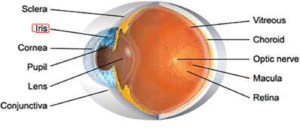
- Cornea: Transparent front part that refracts most of the incoming light.
- Iris: Controls the size of the pupil to regulate light entry.
- Lens: A convex lens that focuses light rays on the retina.
- Retina: Light-sensitive screen containing rods and cones to detect light and colour.
- Ciliary Muscles: Adjust the curvature of the lens for focusing.
- Optic Nerve: Carries visual information to the brain.
All parts of the eye work in coordination to maintain clear vision, making the eye a remarkable optical system.
————————————————————————————————————
Q4. Why does the sky appear blue and the sun reddish during sunrise and sunset?
Approach to Answer:
- Intro: Mention scattering of light.
- Main: Explain short and long wavelength scattering.
- Conclusion: Relate both phenomena to colour perception.
Answer:
The phenomena of the blue sky and red sunrise are due to scattering of sunlight by air molecules in the atmosphere.
Shorter wavelengths (blue and violet) are scattered more than longer wavelengths (red and orange).
During midday, when the Sun is overhead, blue light is scattered most, making the sky appear blue.
During sunrise and sunset, sunlight travels through a thicker layer of atmosphere, so most of the shorter wavelengths are scattered out and only longer wavelengths (red/orange) reach our eyes.
Hence, the sky looks blue during the day and the Sun appears reddish at sunrise and sunset.
————————————————————————————————————
Q5. Explain why stars twinkle but planets do not.
Approach to Answer:
- Intro: Mention the concept of atmospheric refraction.
- Main: Compare size and distance of stars vs. planets.
- Conclusion: State the reason for twinkling in one and stability in the other.
Answer:
The apparent twinkling of stars is due to atmospheric refraction of light.
Stars are very far away and act as point sources of light. Their light passes through several layers of the atmosphere with varying densities, causing continuous bending and changing intensity of light — hence they appear to twinkle.
Planets are much closer and appear as extended sources, so the variations in brightness cancel out.
Therefore, stars twinkle due to variable refraction, while planets do not.
————————————————————————————————————
Q6. Explain why the sky appears black to astronauts even in sunlight.
Approach to Answer:
- Intro: Recall what causes the blue sky on Earth.
- Main: Explain what is missing in space.
- Conclusion: State the final effect.
Answer:
On Earth, the blue colour of the sky is caused by scattering of sunlight by air molecules.
In space, there is no atmosphere to scatter sunlight. Since light travels in a straight line without scattering, no diffused light enters the astronaut’s eyes.
Thus, the sky appears dark or black to astronauts even though the Sun is shining.
————————————————————————————————————
Q7. You are sitting in a plane flying high above the clouds. You notice that the sky outside looks completely dark, even though it’s daytime. Why is it so?
Approach to Answer:
- Intro: Recall what makes the sky appear blue on Earth.
- Main: Explain what changes at high altitudes (less air, less scattering).
- Conclusion: Relate to appearance of the sky from space or at high altitudes.
Answer:
The blue colour of the sky on Earth is due to scattering of sunlight by air molecules in the atmosphere.
At higher altitudes, the atmosphere becomes very thin and contains fewer air molecules. Therefore, insufficient scattering of sunlight occurs, and no diffused light reaches our eyes.
As a result, the sky appears dark or black from a plane or space, even during daytime.
————————————————————————————————————
Q8. During a science fair, a student shows that sunlight passing through a prism produces a colourful band, but a glass slab does not. Explain why.
Approach to Answer:
- Intro: Recall what dispersion is.
- Main: Explain difference in geometry between prism and glass slab.
- Conclusion: State the result for both.
Answer:
Dispersion is the splitting of white light into its constituent colours.
In a prism, the refracting surfaces are inclined, so different colours bend at different angles and separate.
In a glass slab, the two surfaces are parallel, so although dispersion happens at the first surface, the colours recombine at the second surface.
Hence, a prism produces a spectrum, while a glass slab does not.
————————————————————————————————————
Q9. Why do distant mountains appear bluish in colour instead of their actual shade?
Approach to Answer:
- Intro: Recall what causes the blue colour of the sky.
- Main: Apply the same scattering principle to distant mountains.
- Conclusion: Link it to the dominance of scattered blue light.
Answer:
The blue appearance of distant mountains is due to the scattering of sunlight by air molecules and dust particles.
The light coming from mountains passes through layers of air before reaching our eyes.
Shorter wavelengths (blue) are scattered more than longer wavelengths (red), making the light from the mountains appear bluish.
Hence, distant mountains appear bluish due to Rayleigh scattering of light.
————————————————————————————————————
Q10. A photographer explains that sunsets look better in photos taken near the sea because the colours are deeper and warmer. What scientific reason explains this observation?
Approach to Answer:
- Intro: Recall scattering of light during sunrise and sunset.
- Main: Explain how the longer path through the atmosphere enhances red/orange hues.
- Conclusion: Relate to atmospheric thickness near sea level.
Answer:
At sunset, sunlight passes through a thicker layer of the atmosphere before reaching the observer.
Shorter wavelengths like blue and violet get scattered away, and only longer wavelengths (red and orange) reach the observer.
Near the sea, humidity and aerosols increase scattering, enriching the warm colours.
Hence, sunsets near the sea appear deep red or orange, producing more vivid photographs.
————————————————————————————————————
Q11. Why does the colour of the sky change from blue to orange near the horizon during sunset?
Approach to Answer:
- Intro: Recall scattering of light concept.
- Main: Explain the effect of increasing atmospheric thickness near the horizon.
- Conclusion: State which colours dominate and why.
Answer:
The colour of the sky depends on scattering of sunlight by air molecules.
Near the horizon, sunlight travels through a longer path and thicker atmosphere.
Most shorter wavelengths (blue, violet) are scattered out before reaching the observer.
Only longer wavelengths (red, orange, yellow) remain visible.
Hence, the sky near the horizon appears orange or reddish at sunset.
x——————-x——————–x———————–x———————————x
Click the link below to explore more chapter-wise important questions
Class 10 Important Question Answers
x——————-x——————–x———————–x———————————x
5 MARKER QUESTIONS
Q1. Describe the structure and working of the human eye with a labelled diagram.
Approach to Answer:
- Intro: Write a short definition of the human eye as a natural optical instrument.
- Main: Describe main parts and their functions (cornea, iris, lens, retina, etc.) and explain image formation.
- Conclusion: Mention the importance of coordination among eye parts for clear vision.
Answer:
The human eye is a natural optical device that works like a camera. It helps us to see the beautiful world around us by forming real, inverted images on the retina.
- Cornea: Transparent front part that refracts most of the incoming light.
- Iris: Controls the size of the pupil to regulate light entry.
- Lens: A convex lens that focuses light rays on the retina.
- Retina: Light-sensitive screen containing rods and cones to detect light and colour.
- Ciliary Muscles: Adjust the curvature of the lens for focusing.
- Optic Nerve: Carries visual information to the brain.
All parts of the eye work in coordination to maintain clear vision, making the eye a remarkable optical system.
————————————————————————————————————
Q2. What is dispersion of light? Explain with the help of a prism experiment and mention its significance.
Approach to Answer:
- Intro: Define dispersion and white light.
- Main: Explain prism experiment (refraction + separation of colours).
- Conclusion: State what this shows about white light and its components.
Answer:
Dispersion of light is the splitting of white light into its constituent colours when it passes through a prism.
When a beam of white light passes through a glass prism, it bends due to refraction. Each colour bends by a different angle because each has a different wavelength — violet bends the most, red bends the least.
This produces a band of seven colours known as the spectrum (VIBGYOR).
The experiment was first demonstrated by Sir Isaac Newton, proving that white light is a combination of many colours.
Dispersion shows that sunlight is made up of seven colours, and this concept helps us understand natural phenomena like the rainbow.
————————————————————————————————————
Q3. Explain the defects of vision — myopia and hypermetropia — and their correction with diagrams.
Approach to Answer:
- Intro: Define eye defects.
- Main: Explain both defects (causes, image formation) and how to correct them using lenses.
- Conclusion: Mention the importance of correct lens selection.
Answer:
When the eye cannot focus images on the retina clearly, the person suffers from a defect of vision.
The two main defect of vision are discussed as follow
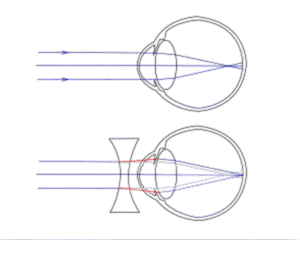
- Myopia (Near-sightedness):
The person can see nearby objects clearly but not distant ones.
The image of a distant object forms in front of the retina.
Cause: Elongated eyeball or high converging power of the lens.
Correction: Using a concave lens to diverge the rays before entering the eye.
- Hypermetropia (Far-sightedness):
The person can see distant objects clearly but not nearby ones.
The image of a nearby object forms behind the retina.
Cause: Shortened eyeball or low converging power of the lens.
Correction: Using a convex lens to converge the rays before entering the eye.
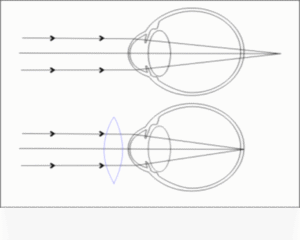
Proper use of concave or convex lenses helps form the image exactly on the retina, ensuring clear vision.
————————————————————————————————————
Q4. What is atmospheric refraction? Explain any two phenomena caused by it in our daily life.
Approach to Answer:
- Intro: Define atmospheric refraction.
- Main: Explain how light bends due to layers of air with varying density. Give two examples (star twinkling, apparent sunrise, etc.).
- Conclusion: Summarize importance or effects.
Answer:
Atmospheric refraction is the bending of light as it passes through layers of air having different densities.
Due to the variation in air density and refractive index, light from objects bends towards the denser layer.
Examples:
- Twinkling of stars: Light from stars undergoes continuous refraction, making them appear to twinkle.
- Apparent sunrise and sunset: The Sun appears above the horizon even when it is below it because its light gets refracted by the atmosphere.
Atmospheric refraction is responsible for many beautiful natural effects like twinkling and apparent shift in the Sun’s position.
————————————————————————————————————
Q5. Explain the formation of the primary and secondary rainbow with the help of a neat labelled diagram.
Approach to Answer:
- Intro: Define rainbow and mention conditions for formation.
- Main: Explain single and double internal reflection in raindrops for primary and secondary rainbow.
- Conclusion: Mention the order of colours and relative brightness.
Answer:
A rainbow forms when sunlight is refracted, internally reflected, and dispersed by water droplets after rain.
- Primary Rainbow:
Formed by one internal reflection inside raindrops.
Red is on the outer side and violet on the inner side. - Secondary Rainbow:
Formed by two internal reflections inside raindrops.
Colours appear reversed — violet outside and red inside.
It appears fainter because of energy loss in the second reflection.
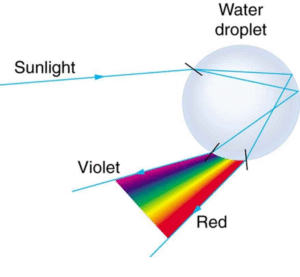
Thus, primary and secondary rainbows show how sunlight undergoes refraction, reflection, and dispersion — demonstrating the composite nature of white light.
————————————————————————————————————
Q6. A student complains of not being able to see the blackboard clearly from the last bench but can easily read a book held close. Identify the defect and explain its cause and correction.
Approach to Answer:
- Intro: Identify the eye defect.
- Main: Explain why it happens (image position, eye shape) and how the defect affects vision.
- Conclusion: Mention lens type used for correction and how it works.
Answer:
The student is suffering from Myopia (Near-sightedness) — a defect where distant objects appear blurred but nearby objects are clear.
In a myopic eye, the image of a distant object forms in front of the retina instead of on it.
This occurs because the eyeball is elongated or the eye lens has excessive converging power.
Correction:
A concave lens of suitable focal length is used. It diverges the incoming light rays so that the image forms exactly on the retina.
Thus, using a concave lens corrects myopia and allows clear vision of distant objects like the blackboard.
————————————————————————————————————
Q7. A man working in a dimly lit factory has difficulty seeing things clearly. The doctor suggests it’s due to ageing. Identify the defect and explain it with correction.
Approach to Answer:
- Intro: Identify the age-related eye defect.
- Main: Explain physiological reason behind it (loss of flexibility, weak ciliary muscles).
- Conclusion: State type of lens used for correction.
Answer:
The man is suffering from Presbyopia, an age-related defect of vision.
With age, the ciliary muscles weaken and the eye lens loses flexibility, reducing the eye’s power of accommodation.
As a result, he cannot focus clearly on nearby objects, especially in dim light.
Correction:
Presbyopia is corrected using bifocal lenses — the upper part (concave) for distant vision and the lower part (convex) for near vision.
Thus, bifocal lenses help restore both near and far vision for aged people
————————————————————————————————————
Q8. A student sitting in a classroom observes that the letters on the board appear blurred, but when she moves forward, they become clear. Later, she finds that close objects also look blurred. What eye condition could this indicate? Explain with correction.
Approach to Answer:
- Intro: Identify possible defect when both near and far objects are unclear.
- Main: Explain cause (loss of accommodation) and its physiological reason.
- Conclusion: Give corrective measure.
Answer:
The student is likely suffering from Presbyopia, a defect in which both near and distant objects cannot be seen clearly.
This defect occurs when the ciliary muscles lose strength and the lens loses elasticity, reducing the eye’s ability to change its curvature.
It commonly develops with age or strain, leading to blurred vision at all distances.
Correction:
It can be corrected using bifocal or progressive lenses, which combine both convex and concave sections to aid near and far vision.
Presbyopia reduces the accommodation range of the eye but can be easily corrected with appropriate lenses.
————————————————————————————————————
Q9. Why do stars appear to twinkle but planets do not, even though both are visible in the night sky? Use the concept of atmospheric refraction.
Approach to Answer:
- Intro: Introduce atmospheric refraction.
- Main: Compare how light from stars and planets travels through the atmosphere.
- Conclusion: Relate size and distance to twinkling effect.
Answer:
Atmospheric refraction is the bending of light as it passes through layers of air with varying densities.
Stars are extremely far and act as point sources of light. As their light passes through multiple air layers, it bends irregularly due to changing air density, making the star’s brightness fluctuate — this is seen as twinkling.
Planets, however, are much closer and appear as extended sources. The multiple light rays from different parts of a planet average out the variations, preventing twinkling.
Hence, stars twinkle while planets do not, due to differences in their distance and the nature of their light.
————————————————————————————————————
Q10. Why do we sometimes see a double rainbow after heavy rainfall? Explain the optical processes involved.
Approach to Answer:
- Intro: Recall rainbow formation.
- Main: Explain difference between primary and secondary rainbow (number of reflections).
- Conclusion: Describe order and brightness of colours.
Answer:
A rainbow forms when sunlight interacts with water droplets through refraction, reflection, and dispersion.
The primary rainbow is formed by one internal reflection within raindrops.
The secondary rainbow appears when light undergoes two internal reflections, emerging at a larger angle.
Because of this, the colour order reverses — violet appears outside and red inside, and it looks fainter due to energy loss in the second reflection.
Hence, a double rainbow occurs due to multiple internal reflections, beautifully revealing the composite nature of sunlight.
x————————–x————————–x———————-x————————-x
Complete and easy NOTES of Class 10 Science Chapter-10 Human Eye and Colourful world —Click here
or visit our NOTES Website — Gyanora.in
x————————–x————————–x———————-x————————-x
Follow us on:
YouTube: www.youtube.com/@Gyanora
Telegram: t.me/gyanora
Instagram: https://www.instagram.com/gyan_ora?igsh=aDQxbDk1aDdleHJ6