Case Study Questions
CASE STUDY 1 – Reaction of Metals with Acids
When zinc granules are added to dilute hydrochloric acid in a test tube, effervescence occurs due to the formation of a gas. The gas burns with a pop sound. The reaction is exothermic, and zinc chloride is formed as a by-product.
(a) Write the balanced chemical equation.
Answer:

(b) What gas is evolved? How is it tested?
Answer: Hydrogen gas; tested by bringing a burning matchstick near it — it burns with a ‘pop’ sound.
(c) Name the type of reaction.
Answer: Displacement reaction.
(d) Why does the test tube become hot?
Answer: Because the reaction is exothermic — it releases heat.
(e) If copper metal were used instead of zinc, would there be any reaction?
Answer: No, because copper is less reactive than hydrogen and cannot displace it from acid.
(f) A: Hydrogen gas is released when acid reacts with a metal.
R: Acids contain replaceable hydrogen atoms.
Answer: Both A and R are true, and R correctly explains A.
(g) A: Copper reacts with dilute HCl to produce H₂ gas.
R: Copper lies below hydrogen in reactivity series.
Answer: A is false, but R is true.
Explanation: Copper cannot displace hydrogen; hence, no reaction occurs.
(h) A: The gas released in the reaction burns with a pop sound.
R: Hydrogen gas is combustible.
Answer: Both A and R are true, and R correctly explains A.
(i) A: Zinc is more reactive than hydrogen.
R: Zinc can displace hydrogen from acid.
Answer: Both A and R are true, and R correctly explains A.
——————————————————————————————————
CASE STUDY 2 – Reaction of Acids with Metal Carbonates
When sodium carbonate reacts with dilute HCl, brisk effervescence occurs due to evolution of carbon dioxide gas. The gas turns lime water milky.
(a) Write the balanced chemical equation.
Answer:

(b) Name the gas evolved and its test.
Answer: Carbon dioxide; turns lime water milky.
(c) Why does lime water turn milky?
Answer: Due to formation of insoluble calcium carbonate:

(d) What happens on passing excess CO₂?
Answer: Milkiness disappears due to formation of soluble Ca(HCO₃)₂.
(e) Identify the type of reaction.
Answer: Acid–carbonate reaction producing salt, water and gas.
——————————————————————————————————
CASE STUDY 3 – Reaction of Acids with Bases (Neutralisation)
During a titration experiment, dilute HCl is added to NaOH solution using phenolphthalein indicator. Initially the solution is pink, but at the end point it becomes colourless.
(a) Write the balanced chemical equation.

(b) What type of reaction is it?
Answer: Neutralisation reaction.
(c) What is the colour change observed?
Answer: Pink to colourless (phenolphthalein indicator).
(d) What does the colour change indicate?
Answer: All acid and base have neutralised each other.
(e) What is the pH of the resulting solution?
Answer: pH = 7 (neutral solution).
(f) A: Neutralisation reaction is a type of double displacement reaction.
R: Acid and base exchange ions to form salt and water.
Answer: Both A and R are true, and R correctly explains A.
Explanation: In neutralisation, H⁺ from acid combines with OH⁻ from base forming H₂O; Na⁺ and Cl⁻ form NaCl.
(g) A: The neutralisation reaction between HCl and NaOH produces hydrogen gas.
R: Metal and acid reaction produces hydrogen gas.
Answer: A is false but R is true.
Explanation: Neutralisation does not release hydrogen; it releases water. Only metals with acids release H₂.
(h) A: The pH of neutral solution is 7.
R: At pH 7, concentration of H⁺ and OH⁻ ions are equal.
Answer: Both A and R are true, and R correctly explains A.
(i) A: Neutralisation reaction is always endothermic.
R: It absorbs heat from surroundings.
Answer: Both A and R are false.
Explanation: Neutralisation is exothermic; it releases heat.
——————————————————————————————————
CASE STUDY 4 – Effect of Acids and Bases on Indicators
A student tests different solutions with litmus, methyl orange, and phenolphthalein indicators.
| Solution | Litmus | Methyl Orange | Phenolphthalein |
| HCl | Red | Red | Colourless |
| NaOH | Blue | Yellow | Pink |
(a) Which solution is acidic? Which is basic?
Answer: HCl → Acidic, NaOH → Basic.
(b) Why does phenolphthalein show different colours?
Answer: It is colourless in acid but pink in base due to pH sensitivity.
(c) Which indicator gives yellow colour in base?
Answer: Methyl orange.
(d) What is the role of indicators in acid–base reactions?
Answer: They detect pH change by colour change.
(e) What will be the colour of litmus in neutral solution?
Answer: Purple (no change).
——————————————————————————————————
CASE STUDY 5 – pH and Everyday Life
A farmer observed poor crop growth. Soil test showed pH = 4.5. In another case, a student had a toothache due to excessive intake of sweets.
(a) Why is pH 4.5 soil unsuitable for crops?
Answer: It is acidic; most plants grow well near pH 7.
(b) How can soil pH be increased?
Answer: By adding slaked lime (Ca(OH)₂) or quicklime (CaO).
(c) Why did tooth decay occur in the student?
Answer: Bacteria produce acids lowering mouth pH below 5.5, eroding enamel.
(d) How can tooth decay be prevented?
Answer: Use basic toothpaste to neutralise mouth acid.
(e) Write two other pH–based daily life examples.
Answer:
- Stomach acidity neutralised by antacids.
- Acid rain affects aquatic life (low pH harmful).
pH is a measure of hydrogen ion concentration. Human blood has pH ≈ 7.4, and tooth decay starts when mouth pH drops below 5.5.
Q1. A: Tooth enamel is unaffected at pH below 5.5.
R: Acidic saliva corrodes tooth enamel.
Answer: A is false, but R is true.
Q2. A: A basic solution has pH greater than 7.
R: It has lower concentration of hydrogen ions compared to hydroxide ions.
Answer: Both A and R are true, and R correctly explains A.
Q3. A: Soil with pH 4.5 is neutral.
R: Neutral substances always have pH equal to 7.
Answer: A is false, but R is true.
Q4. A: Rainwater normally has pH around 5.6.
R: Dissolved carbon dioxide forms carbonic acid in rainwater.
Answer: Both A and R are true, and R correctly explains A.
——————————————————————————————————
CASE STUDY 6 – Water of Crystallisation
A student heats blue copper sulphate crystals. They lose colour and become white. When a few drops of water are added, the blue colour returns.
(a) What happens on heating?
Answer: Water of crystallisation is lost; CuSO₄·5H₂O → CuSO₄ + 5H₂O.
(b) Why does colour return on adding water?
Answer: Hydration forms CuSO₄·5H₂O again.
(c) Name another salt showing this property.
Answer: Gypsum (CaSO₄·2H₂O).
(d) What is the term for water molecules attached to salt?
Answer: Water of crystallisation.
(e) What does this experiment show about salts?
Answer: Some salts contain fixed water molecules giving them colour and structure.
(f) A: Water of crystallisation is necessary to maintain colour of hydrated salts.
R: It maintains crystal structure of the compound.
Answer: Both A and R are true, and R correctly explains A.
(g) A: Anhydrous CuSO₄ is blue in colour.
R: Cu²⁺ ions are colourless.
Answer: Both A and R are false.
Explanation: Anhydrous CuSO₄ is white, hydrated Cu²⁺ ions are blue.
(h) A: Gypsum loses all its water when heated to 373 K.
R: It forms Plaster of Paris at that temperature.
Answer: A is false, but R is true.
Explanation: Gypsum loses only 1.5 molecules of water to form CaSO₄·½H₂O.
(i) A: On adding water to anhydrous CuSO₄, blue colour returns.
R: Rehydration restores crystalline structure.
Answer: Both A and R are true, and R correctly explains A.
——————————————————————————————————
CASE STUDY 7 – Formation of Plaster of Paris
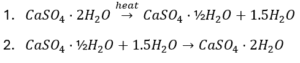
Gypsum is heated at 373 K to form Plaster of Paris (POP). On mixing POP with water, it sets into hard gypsum again.
(a) Write both chemical equations.
Answer:
(b) Why is POP stored in airtight containers?
Answer: It reacts with moisture to form hard gypsum.
(c) Name two uses of POP.
Answer:
- Making casts for fractures,
- Decorative wall designs.
(d) What type of reaction is setting of POP?
Answer: Combination reaction (exothermic).
(e) Why does it feel warm while setting?
Answer: Heat is released during the reaction.
——————————————————————————————————
CASE STUDY 8 – Manufacturing of Baking Soda
In the Solvay process, ammonia, water, carbon dioxide and sodium chloride react to form sodium bicarbonate and ammonium chloride.
(a) Write the balanced equation.

(b) What is the common name of NaHCO₃?
Answer: Baking soda.
(c) State two uses of baking soda.
Answer:
- Baking (releases CO₂ to make dough fluffy).
- Used as antacid to neutralise stomach acid.
(d) Write equation for thermal decomposition of NaHCO₃.
Answer: 
(e) Why is CO₂ useful in baking?
Answer: It makes cakes and breads soft and spongy.
Baking soda (NaHCO₃) and washing soda (Na₂CO₃·10H₂O) are both sodium salts but used differently.
(f) A: Both baking soda and washing soda are acidic salts.
R: They are formed from strong acid and weak base.
Answer: Both A and R are false.
Explanation: They are basic salts formed from weak acid (H₂CO₃) and strong base (NaOH).
(g) A: Washing soda can remove hardness of water.
R: It precipitates calcium and magnesium ions as carbonates.
Answer: Both A and R are true, and R correctly explains A.
(h) A: Baking soda releases carbon dioxide on heating.
R: It decomposes to sodium carbonate, CO₂ and water.
Answer: Both A and R are true, and R correctly explains A.
(i) A: Both salts contain water of crystallisation.
R: Baking soda contains 10 molecules of water.
Answer: A is true, R is false.
Explanation: Only washing soda has 10H₂O; baking soda is anhydrous.
——————————————————————————————————
CASE STUDY 9 – Formation and Uses of Washing Soda
Washing soda (Na₂CO₃·10H₂O) is prepared from sodium carbonate. It removes hardness from water and cleans clothes effectively.
(a) Write chemical equation for its formation.
Answer: 
(b) State two uses of washing soda.
Answer:
- Water softening,
- Cleaning and detergent industries.
(c) Why is it called basic salt?
Answer: It is formed from a weak acid (H₂CO₃) and strong base (NaOH).
(d) What happens when exposed to air?
Answer: It loses water of crystallisation and becomes monohydrate.
(e) Write one difference between washing soda and baking soda.
Answer: Washing soda is Na₂CO₃·10H₂O; baking soda is NaHCO₃.
——————————————————————————————————
CASE STUDY 10 – Bleaching Powder and its Uses
Bleaching powder is produced by passing chlorine gas over dry slaked lime.
(a) Write the balanced equation.
Answer: 
(b) Name the product formed and its chemical formula.
Answer: Calcium oxychloride (CaOCl₂) – bleaching powder.
(c) State two uses of bleaching powder.
Answer:
- Disinfecting drinking water,
- As a bleaching agent in paper and textile industries.
(d) What happens when it is exposed to air?
Answer: It releases chlorine gas slowly.
(e) Which property of chlorine is responsible for bleaching action?
Answer: Oxidising property (chlorine releases nascent oxygen that decolourises substances).
(f) A: Bleaching powder is used for disinfecting water.
R: It liberates chlorine on reaction with water.
Answer: Both A and R are true, and R correctly explains A.
(g) A: Bleaching powder is prepared by passing chlorine gas over dry calcium oxide.
R: CaO reacts with Cl₂ to form CaOCl₂.
Answer: A is false, but R is true.
Explanation: The correct reactant is slaked lime (Ca(OH)₂), not CaO.
(h) A: Bleaching action of CaOCl₂ is due to nascent hydrogen.
R: It acts as a reducing agent.
Answer: Both A and R are false.
Explanation: Bleaching is due to nascent oxygen, an oxidising agent.
(i) A: Bleaching powder should be stored in air-tight containers.
R: It decomposes on exposure to air releasing chlorine gas.
Answer: Both A and R are true, and R correctly explains A.
x———————-x————————x————————x————————-x