Let’s Revise the Topics Covered under this Chapter ( How do Organism Reproduce): [For detailed Understanding, visit our NOTES by CLICK HERE ]
Test your understanding with these important questions designed for Class 10 Science Chapter 7 – How do Organisms Reproduce. Practice them carefully to strengthen your concepts and secure full marks in your Board Exam.
2 MARK QUESTIONS
Q1. Why is variation more common in sexual reproduction than in asexual reproduction?
Approach: Think gamete formation, DNA mixing.
Answer:
Sexual reproduction involves formation and fusion of gametes, where:
- DNA undergoes recombination, producing new gene combinations.
- Offspring receive genes from two parents, increasing variability.
Asexual reproduction copies DNA nearly identically, creating low variation.
——————————————————————————————————-
Q2. Why does regeneration fail in complex organisms like humans?
Approach: Think of specialised cells and body organisation.
Answer:
Complex organisms have highly specialised cells and tissues that cannot revert back to form complete organisms. Their organ systems are interdependent; hence regeneration cannot recreate the whole body.
——————————————————————————————————-
Q3. Why does fertilisation occur only in the oviduct and not in the uterus?
Approach: Think survival of gametes and anatomical location.
Answer:
The oviduct provides the optimal environment for meeting of sperm and ovum. By the time gametes reach the uterus, the ovum may degenerate and the sperm count reduces drastically, preventing fusion.
——————————————————————————————————-
Q4. Why do sexually transmitted diseases spread more through unprotected sexual contact?
Approach: Think body fluids and microorganism transfer.
Answer:
Unprotected sexual contact allows direct exchange of infected body fluids like blood, semen, or vaginal fluid, enabling pathogens like HIV, bacteria, or viruses to enter the bloodstream easily.
——————————————————————————————————-
Q5. Why does menstruation not occur if fertilisation happens?
Approach: Think of hormonal control & uterine lining.
Answer:
After fertilisation, progesterone level remains high which maintains the uterine lining for implantation. Since the lining is not shed, menstruation does not occur.
——————————————————————————————————-
Q6. Explain why external fertilisation involves production of a large number of eggs.
Approach: Think survival probability.
Answer:
External fertilisation exposes eggs to predators, water currents, and environmental hazards. To ensure survival of at least a few, organisms produce millions of eggs.
——————————————————————————————————-
Q7. How does the structure of sperm help it in successful fertilisation?
Approach: Mention adaptations.
Answer:
- Tail helps motility.
- Middle piece provides ATP for movement.
- Acrosome on head helps dissolve egg membrane.
These features help sperm reach and penetrate the ovum.
——————————————————————————————————-
Q8. Why is vegetative propagation advantageous for horticulture industries?
Approach: Think uniformity and economy.
Answer:
It allows rapid production of genetically identical plants with desirable traits like fruit quality and disease resistance, helping farmers maintain uniform crop quality.
——————————————————————————————————-
Q9. Why can’t self-pollination lead to as much variation as cross-pollination?
Approach: Genetic mixing.
Answer:
Self-pollination uses gametes from the same plant, reducing gene mixing. Cross-pollination combines genes from two different parents, causing more variation.
——————————————————————————————————-
Q10. Why do hormones play a major role in regulating the menstrual cycle?
Approach: Discuss feedback mechanism.
Answer:
Hormones like FSH, LH, estrogen and progesterone regulate ovum release and uterine lining preparation. Any change in these hormones alters cycle phases.
——————————————————————————————————-
Q11. Why is vegetative propagation considered advantageous for farmers cultivating plants with poor seed viability? Give two points.
Approach:
Think about how vegetative propagation bypasses seeds and helps farmers maintain quality.
Answer:
- Plants with poor or no seed formation (banana, sugarcane) can still be multiplied using vegetative parts.
- It ensures genetically uniform and high-quality crops, giving predictable yield without seed-related failures.
——————————————————————————————————-
Q12. Give two reasons why DNA copying is essential during reproduction.
Approach:
Think continuity and variation.
Answer:
- Ensures transfer of genetic information from parents to offspring.
- Introduces small, useful variations needed for evolution and survival.
——————————————————————————————————-
Q13. Why is puberty considered an important event in human reproduction?
Approach:
Explain physical and physiological readiness
Answer:
- At puberty, gametes start forming (sperms in boys, ova in girls).
- Development of secondary sexual characters prepares individuals for reproduction.
x——————–x——————-x——————-x——————-x——————x
Explore Complete Care Studies Questions of this Chapter by CLICK HERE
x——————–x——————-x——————-x——————-x——————x
3 MARK QUESTIONS
Q1. Explain why offspring resulting from sexual reproduction show greater adaptability to the environment.
Approach: Think variation, selection, survival.
Answer:
- Sexual reproduction generates broad genetic variation.
- Some variations help individuals survive diseases or climate changes.
- Natural selection favours organisms with advantageous traits, improving adaptability.
——————————————————————————————————-
Q2. Describe the hormonal changes that occur in females before and after ovulation.
Approach: Sequence of FSH → Estrogen → LH → Progesterone.
Answer:
- FSH increases, causing follicle development.
- Estrogen rises, thickening uterus lining.
- LH surge triggers ovulation.
- After ovulation, progesterone rises, maintaining the uterus for pregnancy.
——————————————————————————————————-
Q3. How does the use of copper-T prevent pregnancy? Explain the scientific principle.
Approach: Think sperm motility and implantation.
Answer:
Copper-T releases copper ions that:
- Decrease sperm motility and viability.
- Create hostile uterine environment preventing fertilisation.
- Prevent implantation by irritating uterine lining.
——————————————————————————————————-
Q4. Why can fragmentation be considered an unreliable method of reproduction in complex organisms?
Approach: Stability, specialisation.
Answer:
Fragmentation works only when each piece contains undifferentiated cells. Complex organisms lack such cells, and random breakage would not produce functional individuals.
——————————————————————————————————-
Q5. How does DNA copying introduce both stability and variation?
Approach: Balance between accuracy & errors.
Answer:
- High accuracy ensures basic body plan remains stable.
- Small copying errors during replication create variations, essential for evolution.
——————————————————————————————————-
Q6. Explain the process of fertilisation in flowering plants in three steps.
Approach:
Think pollen landing → fertilisation → zygote formation.
Answer:
- Pollination: Pollen from anther reaches stigma.
- Pollen tube formation: Pollen grain germinates and the tube carries male gametes to ovule.
- Double fertilisation:
-
- One male gamete + egg → zygote
- Second male gamete + polar nuclei → endosperm
This ensures embryo nourishment.
——————————————————————————————————-
Q7. What is fragmentation? Why does it occur only in simple organisms like Spirogyra?
Approach:
Define + reason.
Answer:
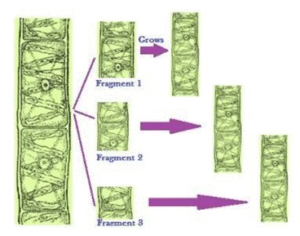
- Fragmentation is when an organism breaks into pieces, and each piece grows into a new individual.
- Occurs only in simple organisms because:
- They have simple body design without complex organs.
- Each fragment contains cells that can divide and grow rapidly.
——————————————————————————————————-
Q8. Why is sexual reproduction considered superior to asexual reproduction? Give three reasons.
Approach:
Focus on variation, fitness, evolution.
Answer:
- Produces genetic variation.
- Helps species adapt to changing environment.
- Ensures evolution and long-term survival.
x——————–x——————-x——————-x——————-x——————x
Click the link below to explore more chapter-wise important questions
Class 10 Important Question Answers
x——————–x——————-x——————-x——————-x——————x
5 MARKS QUESTIONS
Q1. Describe the process of fertilisation in human beings. Explain what changes occur in the uterus if fertilisation occurs and if it does not occur.
Approach:
Break answer into:
- Fertilisation steps
- Uterus changes if fertilisation occurs
- Uterus changes if fertilisation does not occur
Answer:
Fertilisation in humans is an internal and highly selective process. During intercourse, millions of sperms enter the female reproductive tract, but only one succeeds. In the ampulla region of the fallopian tube, the sperm penetrates the ovum’s membrane, and the two haploid nuclei fuse to form a diploid zygote. This fusion restores chromosome number and marks the beginning of a new individual.
If fertilisation occurs:
The uterus immediately prepares for embryo development:
- Zygote divides mitotically while travelling to the uterus.
- Implantation takes place on the thick uterine lining.
- Endometrium becomes more vascular and glandular to nourish the embryo.
- Placenta formation begins for nutrient and waste exchange.
- Progesterone levels remain high, preventing shedding of the uterine lining.
If fertilisation does not occur:
- The ovum degenerates in 24–48 hours.
- The thickened uterine lining breaks down.
- Menstruation occurs, marking Day 1 of the next cycle.
——————————————————————————————————-
Q2. Explain regeneration and fragmentation with suitable examples. Why complex organisms cannot regenerate a whole body?
Approach: Write separately:
- Regeneration
- Fragmentation
- Why complex animals fail to regenerate
Answer:
- Regeneration
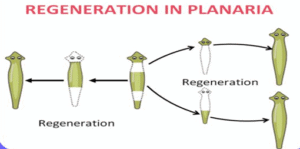
Regeneration is the capability of organisms to rebuild lost body parts using specialised regenerative cells.
Example:
- Planaria → A single piece can grow into a complete organism.
- This happens because their cells are totipotent-like and can divide + differentiate freely.
- Fragmentation
It is an asexual mode of reproduction where the organism breaks into fragments, and each fragment grows into a new individual.
Example:
- Spirogyra filament, which under favourable conditions grows into separate individuals after breaking naturally.
The complex organisms cannot regenerate fully because:
Complex multicellular organisms (e.g., humans, birds, mammals):
- Have highly specialised and differentiated cells.
- Body organisation is divided into organs and organ systems, not simple tissues.
- Differentiated cells lose ability to form all cell types.
- Regeneration is limited only to specific tissues (skin, liver).
- Entire organism regeneration would disturb system-level organisation.
Thus, higher organisms can repair, but not recreate themselves.
——————————————————————————————————-
Q3. Describe the structure and functions of the human placenta. Why is it essential for embryonic development?
Approach:
- Structure
- Functions
- Importance
Answer:
The placenta is a temporary, disc-shaped life-support organ formed during pregnancy where the chorionic villi of the embryo interlock with maternal uterine tissues. Although both contain blood vessels, maternal and fetal blood never mix; exchange happens by diffusion.
Functions of Placenta:
- Nutrition: Transfers glucose, amino acids, fatty acids.
- Respiration: Supplies O₂ and removes CO₂ from fetal blood.
- Excretion: Removes nitrogenous wastes into maternal blood.
- Protection: Provides passive immunity by transferring antibodies.
- Hormonal Role: Produces hCG, progesterone, and oestrogen to maintain pregnancy.
The placenta is essential for embryonic development because of the following reasons:
Without the placenta, the embryo cannot:
- receive nutrients,
- exchange gases,
- remove wastes,
- or maintain the uterine environment.
Thus, the placenta acts as the nutritional bridge and lifeline between mother and fetus.
——————————————————————————————————-
Q4. Compare sexual reproduction in flowering plants and humans under: (a) Gamete formation (b) Site of fertilisation (c) Embryo development
Approach: Use a comparison table for maximum marks.
Answer:
| Feature | Flowering Plants | Human Beings |
| (a) Gamete Formation | Male gametes formed inside pollen grains in anthers; female gametes inside embryo sac in ovules. | Sperms formed in testes; ova formed in ovaries through meiosis. |
| (b) Site of Fertilisation | Takes place inside ovule via pollen tube. | Takes place in fallopian tube (ampulla region). |
| (c) Embryo Development | Zygote develops into embryo inside seed after fertilisation. | Zygote divides, forms embryo → implants in uterus, nourished by placenta. |
This structured comparison shows how plants and humans follow the same basic pattern—gamete formation → fertilisation → embryo formation—yet differ in structures and mechanisms.
——————————————————————————————————-
Q5. Explain the menstrual cycle in human females. Why is it important for reproduction? Mention major hormonal changes.
Approach: Describe cycle in phases + hormones + reason for importance.
Answer:
The menstrual cycle is a 28-day rhythmic process that prepares the female body for pregnancy.
- Menstrual Phase (Day 1–5)
- Uterine lining sheds → menstrual bleeding.
- FSH rises to stimulate follicle growth.
- Follicular Phase (Day 6–13)
- Ovarian follicle matures.
- Oestrogen increases, causing thickening of endometrium.
- Ovulation (Day 14)
- A sudden LH surge causes release of the mature ovum.
- Luteal Phase (Day 15–28)
- Empty follicle becomes corpus luteum.
- Progesterone increases, maintaining uterine lining.
- If no fertilisation → progesterone falls → menstruation begins again.
Importance of Menstrual Cycle:
- Prepares uterus for implantation.
- Ensures release of a mature ovum each month.
- Maintains hormonal balance for pregnancy.
- Resets reproductive system in absence of fertilisation.
This cycle is essential to ensure successful ovulation, fertilisation, and pregnancy.
——————————————————————————————————-
Q6. Describe the process of binary fission in amoeba. How is multiple fission different from binary fission? Why is fission an efficient method for unicellular organisms?
Approach: Cover in order:
- Binary fission steps
- Definition + difference of multiple fission
- Why fission is efficient for unicellular organisms
Answer:
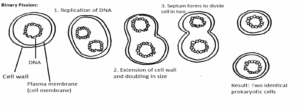
Binary fission is the most common asexual reproduction method in Amoeba, where one parent cell divides into two identical daughter cells.
Process of Binary Fission:
- Nucleus elongates and undergoes mitotic division.
- Cytoplasm begins to constrict from the middle.
- The parent cell splits into two genetically identical daughter amoebae.
- Each new cell grows independently to form a mature amoeba.
Multiple Fission vs Binary Fission:
- In binary fission, → one cell → two daughter cells.
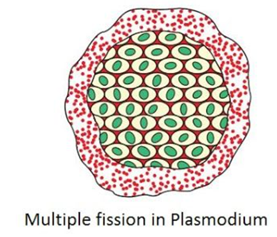
- In multiple fission, → one cell → many daughter cells at once.
- Example: Plasmodium (malarial parasite).
- Occurs under unfavourable conditions, inside a cyst.
Fission is efficient for unicellular organisms because of the following reasons:
- Requires no mate → saves energy.
- Very fast reproduction.
- Produces large populations quickly.
- All offspring are well adapted to the same environment.
- Cell simply divides → no complex organs needed.
——————————————————————————————————-
Q7. Explain the role of hormones in the male and female reproductive system. How do hormones regulate puberty and reproduction?
Approach: Explain separately:
- Male hormones
- Female hormones
- Regulation of puberty
- Regulation of reproduction
Answer:
Hormones control growth, maturation, and functioning of reproductive organs.
- Male Reproductive Hormones:
- Testosterone (from testes)
- Develops secondary sexual characters
- Deepens voice, increases muscle mass
- Stimulates sperm production
- FSH (Follicle Stimulating Hormone)
- Helps in sperm maturation
- Female Reproductive Hormones:
- Oestrogen
- Controls development of secondary characters
- Thickens uterine lining
- Progesterone
- Maintains uterus for pregnancy
- Prevents breakdown of endometrium
- FSH → Helps follicle mature
- LH → Triggers ovulation
Regulation of Puberty:
- Pituitary gland releases FSH & LH.
- These stimulate testes/ovaries to produce testosterone & oestrogen.
- Leads to development of sexual maturity.
- Regulation of Reproduction:
- FSH stimulates gamete production (sperms/ova).
- LH regulates ovulation.
- Oestrogen builds uterine lining.
- Progesterone maintains lining after ovulation.
- Hormonal feedback ensures cyclic fertility in females.
Hormones thus synchronise puberty, menstruation, fertilisation, and pregnancy.
——————————————————————————————————-
Q8. Explain sexual reproduction in flowering plants. Describe pollination, fertilisation, seed formation, and fruit development.
Approach: Explain in sequence:
- Pollination
- Fertilisation
- Seed formation
- Fruit formation
Answer:
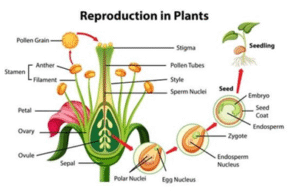
Sexual reproduction in flowering plants involves the formation of male and female gametes and the fusion of these gametes.
- Pollination
Transfer of pollen grains from anther to stigma.
Types:
- Self-pollination
- Cross-pollination (more genetic variety)
Agents include wind, insects, water, and animals.
- Fertilisation
- Pollen grain germinates on the stigma.
- Pollen tube grows through style toward ovule.
- Male gametes travel inside the pollen tube.
- One gamete fuses with the egg → zygote.
- Other fuses with polar nuclei → endosperm (double fertilisation).
- Seed Formation
- Zygote → develops into embryo.
- Ovule → becomes seed.
- Seed contains embryo, cotyledons, and seed coat.
- Fruit Formation
- Ovary enlarges and becomes fruit.
- Protects seed and helps in dispersal.
Thus plants efficiently produce new generations through pollination and double fertilisation.
——————————————————————————————————-
Q9. Define vegetative propagation. Explain any three artificial vegetative propagation methods with examples.
Approach:
- Define vegetative propagation
- Explain 3 methods clearly
Answer:
Vegetative propagation is asexual reproduction in plants where new plants grow from vegetative parts like roots, stems, and leaves.
- Cutting:
- A portion of root/stem/leaf is cut and planted.
- Grows into a new plant under suitable conditions.
- Example: Rose, Hibiscus.
- Layering:
- A lower branch is bent to the ground.
- A part is covered with soil while still attached to the parent.
- After roots form, the new plant is cut off.
- Example: Jasmine, Bougainvillea.
- Grafting:
- Small branch (scion) of desired plant joined to the root system (stock) of another plant.
- Both fuse and grow as one plant.
- Example: Mango, Apple.
Vegetative propagation helps produce genetically identical, fast-growing, disease-resistant plants.
——————————————————————————————————-
Q10. Describe the entire journey of sperm from ejaculation to fertilisation. How do structural adaptations of sperm help it in the process?
Approach:
- Path of sperm
- Adaptations
Answer:
After ejaculation, millions of sperms travel through a long and challenging path to reach the ovum.
Journey of Sperm:
- Enters vagina.
- Moves through cervix into the uterus.
- Travels towards the fallopian tubes.
- Only a few hundred reach near the ovum.
- One sperm penetrates the egg → fertilisation occurs in the ampulla of fallopian tube.
Structural Adaptations of Sperm:
- Head: Contains nucleus + enzymes (acrosome) for penetrating egg membrane.
- Middle piece: Full of mitochondria → provides energy for swimming.
- Tail: Enables fast, whip-like movements.
- Streamlined shape: Reduces resistance in fluid-filled tract.
These adaptations make the sperm a highly specialised cell designed for successful fertilisation.
x———————–x————————x———————–x————————x
Complete and easy NOTES of Class 10 Science Chapter 7 (How Do Organisms Reproduce?) — Read here
or visit our NOTES Website — Gyanora.in
x———————–x———————-x———————–x—————————x
Follow us on:
Youtube: www.youtube.com/@Gyanora
Telegram: t.me/gyanora
Instagram: https://www.instagram.com/gyan_ora?igsh=aDQxbDk1aDdleHJ6