2 MARKER QUESTIONS
Q1. Carbon forms millions of compounds. State and explain any two reasons.
Approach:
- Recall special abilities of carbon (self-bonding + 4 bonds).
- Think about how these create huge variety in structures.
- Connect to examples like chains, rings, multiple bonds.
Answer:
Carbon forms a large number of compounds because:
- Catenation: Carbon atoms bond with themselves forming long chains, branched chains, and rings.
- Tetravalency: Carbon forms four strong covalent bonds with atoms like H, O, N, Cl, allowing diverse structures.
——————————————————————————————————–
Q2. Why does carbon prefer covalent bonding instead of ionic bonding?
Approach:
- Look at carbon’s electronic configuration → 4 valence electrons.
- Compare energy needed to lose/gain electrons.
- Conclude that sharing is the easiest.
Answer:
Carbon has configuration 2,4.
- It cannot lose 4 electrons—requires too much energy.
- It cannot gain 4 electrons—C⁴⁻ becomes highly unstable.
Thus, carbon shares electrons and forms covalent bonds.
——————————————————————————————————–
Q3. State two differences between saturated and unsaturated hydrocarbons.
Approach:
- Compare based on type of bonds (single vs double/triple).
- Compare reaction types seen in the chapter.
- Link to general formula if needed.
Answer:
- Saturated hydrocarbons have all single bonds, while unsaturated hydrocarbons have double or triple bonds.
- Unsaturated hydrocarbons show addition reactions, while saturated ones show substitution reactions.
——————————————————————————————————–
Q4. Why is graphite a good conductor but diamond is not?
Approach:
- Think about free electrons.
- Compare structure: layered vs rigid 3D.
- Relate structure → conductivity.
Answer:
Graphite has one free electron per carbon atom due to layered structure, enabling electrical conduction.
Diamond has no free electrons as all four valence electrons form covalent bonds, making it non-conducting.
——————————————————————————————————–
Q5. Why are most carbon compounds poor conductors of electricity?
Approach:
- Recall no ions → covalent nature.
- Think about absence of free electrons.
- Connect to “why electricity needs charges.”
Answer:
Carbon compounds form covalent bonds, which do not produce ions or free electrons.
Hence they cannot conduct electricity.
——————————————————————————————————–
Q6. Write the electron dot structure of methane and ethene.
Approach:
- Count valence electrons.
- Arrange atoms according to bonding rules.
- Show shared electron pairs clearly.
Answer:
Methane (CH₄):
H · · C · · H
(4 single covalent C–H bonds)
Ethene (C₂H₄):
H · · C = C · · H
(Double bond between two carbon atoms)
——————————————————————————————————–
Q7. Why do carbon compounds have generally low melting and boiling points?
Approach:
- Think weak intermolecular forces in covalent compounds.
- Compare with ionic compounds.
- Link to “less energy needed.”
Answer:
Carbon compounds have weak intermolecular forces, not strong ionic forces.
So less energy is needed to break the forces → Low melting/boiling points.
——————————————————————————————————–
Q8. Convert ethanol to ethene. State the reaction involved.
Approach:
- Recall dehydration reaction.
- Use conc. acid as dehydrating agent.
- Recognize product = alkene.
Answer:
Ethanol → Ethene by dehydration.
CH₃CH₂OH → CH₂=CH₂ + H₂O
(Reagent: Conc. H₂SO₄)
——————————————————————————————————–
Q9. Why does soap not form lather in hard water?
Approach:
- Recall ions present in hard water.
- Think about scum formation.
- Link to decreased lathering.
Answer:
Hard water contains Ca²⁺ and Mg²⁺ ions, which react with soap to form insoluble scum.
Thus, soap cannot form lather.
——————————————————————————————————–
Q10. What is esterification? Write a general reaction.
Approach:
- Think “acid + alcohol → pleasant smell.”
- Recall water is always formed.
- Learn the general reaction pattern.
Answer:
Esterification is the reaction between carboxylic acid and alcohol to form ester + water.
General reaction:
RCOOH + R’OH → RCOOR’ + H₂O
x———————-x———————–x———————–x————————–x
3 MARKER QUESTIONS
Q1. Explain isomers with reference to butane. Give structural formulas.
Approach:
- Define isomers first.
- Show both structures clearly
- Compare them briefly.
Answer:
Isomers are compounds having the same molecular formula but different structures.
Butane (C₄H₁₀) has two isomers:
- n-Butane: CH₃–CH₂–CH₂–CH₃
- Iso-butane:
CH₃
│
CH₃–C–CH₃
Their properties differ due to different structural arrangements.
——————————————————————————————————–
Q2. Explain the hydrogenation reaction of unsaturated hydrocarbons with example.
Approach:
- Recall “hydrogen + catalyst.”
- Understand it’s an addition reaction.
- Link to everyday use (oils → fats).
Answer:
Hydrogenation is the addition of hydrogen to unsaturated hydrocarbons in presence of Ni/Pd catalyst.
Example:
CH₂=CH₂ + H₂ → CH₃–CH₃
(ethene → ethane)
It converts liquid oils into solid fats.
——————————————————————————————————–
Q3. Describe the reaction of sodium with ethanol. Give the balanced equation.
Approach:
- Think observation: bubbles (H₂ gas).
- Recall sodium alkoxide forms.
- Write the balanced equation.
Answer:
Sodium reacts vigorously with ethanol producing hydrogen gas and sodium ethoxide.
Reaction:
2CH₃CH₂OH + 2Na → 2CH₃CH₂ONa + H₂↑
Effervescence is observed due to hydrogen evolution.
——————————————————————————————————–
Q4. Explain why detergents work in hard water while soaps do not.
Approach:
- Compare how soaps and detergents react with Ca²⁺/Mg²⁺.
- Focus on scum vs no scum.
- Mention solubility difference.
Answer:
Soaps react with Ca²⁺/Mg²⁺ of hard water to form insoluble scum, reducing cleaning efficiency.
Detergents contain sulphonate groups, forming soluble salts even with hard water ions.
Thus detergents remain effective in hard water.
——————————————————————————————————–
Q5. Explain the functional group –COOH with one chemical property and one example.
Approach:
- Identify the group and its nature (acidic).
- Give one simple example.
- Give one equation to show reactivity.
Answer:
–COOH is the carboxyl group, responsible for acidic nature.
Example: Ethanoic acid (CH₃COOH).
Chemical property: Reaction with bases
CH₃COOH + NaOH → CH₃COONa + H₂O
——————————————————————————————————–
Q6. Differentiate between addition and substitution reactions using suitable examples.
Approach:
- Learn “unsaturated → addition,” “saturated → substitution.”
- Give one simple equation for each.
- Highlight difference in bond types.
Answer:
- Addition Reaction: Occurs in unsaturated hydrocarbons.
Example:
CH₂=CH₂ + H₂ → CH₃–CH₃ - Substitution Reaction: Occurs in saturated hydrocarbons.
Example:
CH₄ + Cl₂ → CH₃Cl + HCl (sunlight)
——————————————————————————————————–
Q7. Explain saponification with equation.
Approach:
- Recall ester + base reaction.
- Think soap + alcohol formation.
- Mention industrial use.
Answer:
Saponification is the reaction in which an ester reacts with a base to form soap + alcohol.
Reaction:
Fat (ester) + NaOH → Soap + Glycerol
This reaction is used in soap industry.
——————————————————————————————————–
Q8. Why does ethanol act as a good solvent? Give any two reasons.
Approach:
- Think dual nature: polar + non-polar.
- Mention hydrogen bonding.
- Link to dissolving variety of substances.
Answer:
Ethanol dissolves many organic and inorganic substances because:
- It has both polar (–OH) and non-polar (C₂H₅) parts.
- It forms hydrogen bonds, enhancing solubility of many compounds.
——————————————————————————————————–
Q9. Explain the term homologous series. State any two characteristics.
Approach:
- Define in simple line.
- Highlight “CH₂ difference.”
- Mention gradual property change.
Answer:
A homologous series is a group of organic compounds with the same functional group and general formula.
Characteristics:
- Members differ by –CH₂– unit.
- They show gradual change in physical properties.
——————————————————————————————————–
Q10. Describe the combustion reaction of carbon compounds with examples.
Approach:
- Recall products (CO₂ + H₂O).
- Highlight heat + light release.
- Give example of complete + incomplete.
Answer:
Carbon compounds burn in presence of oxygen to form CO₂ + H₂O, releasing heat and light.
Example:
CH₄ + 2O₂ → CO₂ + 2H₂O + heat
Incomplete combustion produces CO.
x———————-x———————–x———————–x————————–x
5 MARKER QUESTIONS
Q1. Explain the different types of bonding in carbon compounds. Why are covalent bonds strong? Illustrate with examples.
Approach:
- Mention three bond types (single, double, triple).
- Explain how covalent bonds form.
- Add why they are strong (overlap, shared electrons).
Answer:
Carbon forms covalent compounds due to its tetravalency and inability to form ionic bonds. Covalent bonds involve sharing of electrons.
The different types of bonding in carbon compounds are as follow:
- Single Covalent Bonds (σ-bonds):
Example: Methane (CH₄) where carbon shares four electron pairs with hydrogen. - Double Covalent Bonds:
Example: Ethene (CH₂=CH₂) with one sigma and one pi bond. - Triple Covalent Bonds:
Example: Ethyne (HC≡CH) with one sigma and two pi bonds.
Following are the reasons that shows why Covalent Bonds are Strong:
- Shared electron pairs are held closely between atoms.
- No ions → no electrostatic repulsion.
- Overlapping orbitals create strong bonding.
Thus, carbon forms stable covalent compounds with diverse structures and strong bonds.
——————————————————————————————————–
Q2. Explain isomerism in carbon compounds. Describe types of isomerism with examples.
Approach:
- Start with definition.
- Break into structural + geometrical.
- Give simple examples for each.
Answer:
Isomerism occurs when compounds have the same molecular formula but different structures or arrangements.
There are two different types of isomerism:
- Structural Isomerism:
- Chain Isomerism: Different carbon chain arrangements.
Example: n-butane and isobutane. - Position Isomerism: Functional group at different positions.
Example: 1-propanol and 2-propanol. - Functional Isomerism: Same formula but different functional groups.
Example: ethanol (C₂H₅OH) and dimethyl ether (CH₃–O–CH₃).
- Chain Isomerism: Different carbon chain arrangements.
- Geometrical Isomerism: (For alkenes)
cis- and trans-isomers due to restricted rotation.
Example: cis-2-butene and trans-2-butene.
Isomerism increases the structural diversity of organic compounds.
——————————————————————————————————–
Q3. Discuss the chemical properties of ethanol and ethanoic acid (any four each). Compare them briefly.
Approach:
- Separate properties of both in points.
- Add chemical equations.
- Add a short comparison table.
Answer:
Ethanol and ethanoic acid are important carbon compounds with distinct chemical properties.
Chemical properties of Ethanol:
- Oxidation: Ethanol → Ethanoic acid.
- Dehydration: Ethanol → Ethene.
- Reaction with Sodium: Produces sodium ethoxide + H₂.
- Combustion: Produces CO₂ + H₂O.
Chemical properties of Ethanoic Acid:
- Reaction with Carbonates: Produces CO₂.
- Reaction with Alcohol (Esterification): Forms esters.
- Reaction with Bases: Produces salt + water.
- Reaction with Metals: Produces hydrogen.
Comparison:
- Ethanol is neutral, ethanoic acid is acidic.
- Ethanol forms esters, ethanoic acid is used to make esters.
Thus, both compounds show characteristic reactions but differ in acidity.
——————————————————————————————————–
Q4. Describe soaps and detergents. Explain their cleansing action with diagrams.
Approach:
- Define each clearly.
- Explain micelle formation in steps.
- Compare hard water performance.
Answer:
Soaps and detergents are cleansing agents used to remove dirt and grease.
Soaps:
- Sodium or potassium salts of fatty acids.
- Not effective in hard water.
Detergents:
- Sodium salts of long-chain benzene sulphonates.
- Effective in hard water.
Cleansing Action (Micelle Formation):
- Soap molecules form micelles where hydrophobic tails trap oil.
- Hydrophilic heads face water, allowing dirt to wash away.
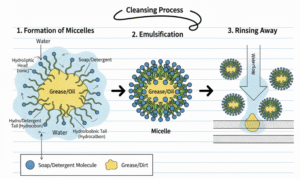
Both clean by micelle formation, but detergents work better in hard water.
——————————————————————————————————–
Q5. Explain homologous series in detail. Write its characteristics and significance.
Approach:
- Start with definition.
- List 4 characteristics clearly.
- Add its importance in organic chemistry.
Answer:
Homologous series is a group of organic compounds with same functional group and general formula.
Characteristics:
- Members differ by –CH₂– (14 u).
- Gradual change in physical properties (boiling point increases).
- Similar chemical properties.
- Can be represented by a general formula.
Significance:
- Makes study of organic chemistry easier.
- Predictable properties.
- Helps systematic classification.
Homologous series simplifies the understanding of organic compounds.
——————————————————————————————————–
Q6. Explain oxidation and reduction in carbon compounds with suitable equations.
Approach:
- Define both in organic sense.
- Give one example each.
- Mention oxidising agents.
Answer:
Oxidation and reduction in organic chemistry involve the addition or removal of oxygen or hydrogen.
Oxidation:
- Addition of oxygen or removal of hydrogen.
- Example:
Ethanol + alkaline KMnO₄ → Ethanoic acid.
Reduction:
- Addition of hydrogen or removal of oxygen.
- Example:
Ethene + H₂ → Ethane (hydrogenation).
Oxidising agents: KMnO₄, K₂Cr₂O₇.
Thus, oxidation and reduction transformations are key in organic synthesis.
——————————————————————————————————–
Q7. Explain substitution reaction in detail. Why do only saturated hydrocarbons show substitution?
Approach:
- Define the reaction.
- Give methane–chlorine example.
- Explain why only saturated hydrocarbons show it.
Answer:
Substitution reactions occur when one atom replaces another in a molecule.
Example:
CH₄ + Cl₂ → CH₃Cl + HCl (sunlight)
Here, Cl replaces H.
Reason for Saturated Hydrocarbons:
- Saturated hydrocarbons have stable single bonds.
- These bonds require high energy UV light for replacement.
- Unsaturated hydrocarbons undergo addition instead.
Thus, substitution reactions are characteristic of saturated hydrocarbons.
——————————————————————————————————–
Q8. Write a detailed note on esterification and saponification. Explain their role in daily life.
Approach:
- Define each reaction separately.
- Give equations.
- Add daily life uses.
Answer:
Esterification and saponification are opposite reactions involving esters.
Esterification:
Alcohol + Acid → Ester + Water
Example:
CH₃COOH + C₂H₅OH → CH₃COOC₂H₅ + H₂O
Ester has fruity smell.
Saponification:
Ester + Base → Soap + Alcohol
Example:
Fat + NaOH → Soap + Glycerol
Used in soap-making industry.
Uses:
- Esters used in perfumes.
- Saponification produces soaps.
Both reactions have major industrial importance.
——————————————————————————————————–
Q9. Discuss in detail the difference between soaps and detergents. Explain why detergents are preferred in industries.
Approach:
- Compare in table style (properties).
- Explain why detergents work in hard water.
- Mention industrial advantages.
Answer:
Soaps and detergents differ in composition and action.
Soaps:
- Sodium salts of fatty acids.
- Form scum in hard water.
Detergents:
- Sodium salts of alkylbenzene sulphonic acids.
- Soluble in hard water.
- Work in acidic and alkaline medium.
- Strong cleansing action.
Industrial Preference:
- Do not form scum.
- Can work in mineral-rich water.
- Stable in alkaline media used in industries.
Detergents are chemically superior for large-scale cleaning.
——————————————————————————————————–
Q10. Explain in detail how carbon forms such a vast number of compounds. Discuss catenation, tetravalency, and versatile bonding.
Approach:
- Summarize three main reasons: catenation, tetravalency, versatile bonding.
- Add isomerism for diversity.
- Mention examples for each.
Answer:
Carbon is known for forming millions of compounds due to unique bonding abilities.
Catenation:
Carbon chains can be long, branched, or ring-shaped.
Example: C₆H₆, C₈H₁₈.
Tetravalency:
Carbon forms four covalent bonds, providing structural stability.
Versatile Bonding:
Forms:
- Single (CH₄)
- Double (C₂H₄)
- Triple bonds (C₂H₂)
- Strong bonds with O, N, S, Halogens.
Isomerism:
Same formula → different structures → diversity.
Due to these reasons, carbon chemistry is extremely diverse.
x———————-x———————–x———————–x————————–x