Table of Contents
ToggleTopic 1: Economic Activities
Question 1
Why is earning an income considered the key feature of an economic activity? Explain with suitable examples.
Approach to the Answer
- Explain the meaning of economic activities.
- Highlight the purpose of earning income.
- Support with examples.
Answer
Economic activities are those activities that are undertaken to earn income or a livelihood. The main objective of these activities is to produce goods or provide services in return for money.
For example:
- A doctor treating patients in a hospital for a salary performs an economic activity.
- A farmer growing crops for sale is engaged in an economic activity.
- A shopkeeper selling goods to customers is also performing an economic activity.
Thus, the intention to earn income is the key feature that distinguishes economic activities from other human activities.
x——————–x——————–x——————–x——————–x——————–x——————–x
Question 2
Explain why every human activity cannot be classified as an economic activity.
Approach to the Answer
- Explain the basis of economic activities.
- Differentiate between economic and non-economic activities.
- Give suitable examples.
Answer
Not every human activity is an economic activity because not all activities are performed to earn income.
Economic activities are undertaken to earn money or a livelihood, whereas non-economic activities are performed out of love, affection, social service, or personal satisfaction.
For example:
- A teacher teaching in a school for a salary is performing an economic activity.
- A mother cooking food for her family or a person helping a neighbour without payment is performing a non-economic activity.
Therefore, only those activities that generate income are called economic activities.
x——————–x——————–x——————–x——————–x——————–x——————–x
Question 3
How do economic activities contribute to the growth and development of an economy?
Approach to the Answer
- Explain the role of economic activities.
- Mention their contribution to production.
- Conclude with their importance.
Answer
Economic activities play a vital role in the development of an economy because they involve the production of goods and services required by society.
They contribute to the economy by:
- Producing goods and services to satisfy human wants.
- Providing employment opportunities to people.
- Generating income and improving the standard of living.
- Contributing to the country’s economic growth.
Thus, economic activities form the foundation of all productive activities in an economy.
x——————–x——————–x——————–x——————–x——————–x——————–x
Question 4
A person spends the morning teaching in a school and the evening teaching underprivileged children free of cost. Which of these activities is an economic activity? Give reasons.
Approach to the Answer
- Identify both activities.
- Explain the basis of classification.
- Justify the answer.
Answer
Only the activity of teaching in a school for a salary is an economic activity because it is performed to earn income.
Teaching underprivileged children free of cost is a non-economic activity because no income is earned from it.
The distinction is based on the purpose of the activity:
- If the activity is performed to earn a livelihood, it is an economic activity.
- If it is performed without any financial benefit, it is a non-economic activity.
Hence, earning income is the deciding factor in identifying an economic activity.
x——————–x——————–x——————–x——————–x——————–x——————–x
Question 5
Why is the concept of economic activities important for understanding the economy?
Approach to the Answer
- Explain the concept of economic activities.
- State why they are important.
- Relate them to the study of the economy.
Answer
Economic activities are important because they involve the production and provision of goods and services that satisfy human wants.
The concept helps us to:
- Understand how people earn their livelihood.
- Identify different types of productive work in an economy.
- Study how goods and services are produced.
- Classify economic activities into different sectors for better understanding.
Thus, understanding economic activities is the first step towards understanding the structure and functioning of an economy.
x——————–x——————–x——————–x——————–x——————–x——————–x
Question 6
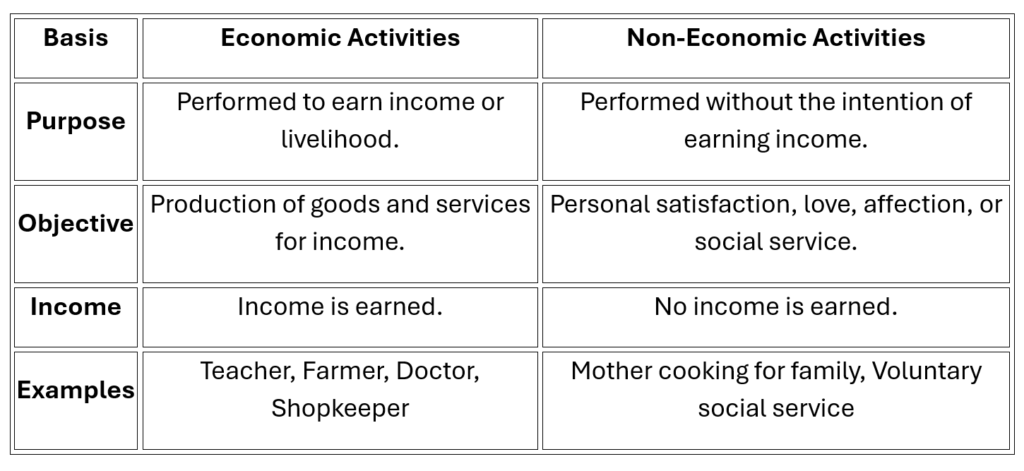
Differentiate between economic activities and non-economic activities with suitable examples.
Approach to the Answer
- Define both types of activities.
- Compare them on key points.
- Support with examples.
Answer
Economic and non-economic activities differ mainly in their purpose.
Topic 2: Three Sectors of the Economy
Question 1
Why has the economy been classified into three sectors? Explain the basis of this classification and its significance.
Approach to the Answer
- Explain the need for classification.
- Mention the basis of classification.
- State its significance.
Answer
An economy consists of different types of economic activities. To study them in a systematic way, they are classified into three sectors.
- Primary Sector: It includes activities that use natural resources directly, such as agriculture, fishing, and mining.
- Secondary Sector: It includes activities that convert raw materials into finished goods through manufacturing.
- Tertiary Sector: It includes activities that provide services to support production and meet the needs of consumers.
The classification is based on the nature of economic activities, which helps in understanding the role of each sector.
Thus, the three-sector classification makes the study of the economy simple and systematic.
x——————–x——————–x——————–x——————–x——————–x——————–x
Question 2
“The three sectors of the economy perform different functions, yet each contributes to the overall development of the economy.” Analyse the statement.
Approach to the Answer
- Explain the role of each sector.
- Show their contribution.
- Conclude briefly.
Answer
Each sector performs a different type of economic activity, but all are important for the economy.
- The Primary Sector provides raw materials by using natural resources.
- The Secondary Sector converts these raw materials into finished goods through manufacturing.
- The Tertiary Sector provides services such as transport, banking, education, and healthcare, which support production and consumers.
All three sectors work together and contribute to economic development.
Hence, every sector plays an essential role in the growth of the economy.
x——————–x——————–x——————–x——————–x——————–x——————–x
Question 3
A cotton farmer grows cotton, a textile factory manufactures cloth, and a shopkeeper sells the cloth to consumers. Identify the sector involved at each stage and explain its role.
Approach to the Answer
- Identify the sectors.
- Explain the role of each.
- Relate them to the production process.
Answer
The production and sale of cloth involve all three sectors of the economy.
- Cotton Farmer – Primary Sector: The farmer produces cotton by using natural resources.
- Textile Factory – Secondary Sector: The factory converts raw cotton into cloth through manufacturing.
- Shopkeeper – Tertiary Sector: The shopkeeper provides the service of selling the finished product to consumers.
Each sector performs a different function and helps complete the production process.
Thus, all three sectors are interconnected and work together.
x——————–x——————–x——————–x——————–x——————–x——————–x
Question 4
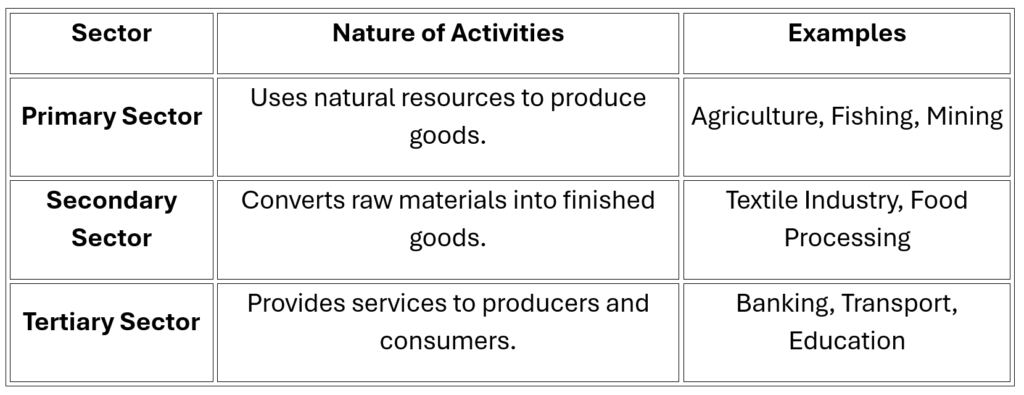
Compare the Primary, Secondary, and Tertiary Sectors on the basis of the nature of activities performed.
Approach to the Answer
- Compare all three sectors.
- Mention the nature of activities.
- Give suitable examples.
Answer
The three sectors differ according to the nature of economic activities they perform.
x——————–x——————–x——————–x——————–x——————–x——————–x\
Question 5
Why is the balanced growth of all three sectors necessary for the development of an economy?
Approach to the Answer
- Explain the role of each sector.
- Show their interdependence.
- Conclude briefly.
Answer
No single sector can meet all the needs of an economy. Each sector depends on the others for smooth functioning.
- The Primary Sector supplies raw materials.
- The Secondary Sector manufactures goods using these raw materials.
- The Tertiary Sector provides services such as transport, communication, and trade that support production and distribution.
The growth of one sector encourages the growth of the others.
Hence, balanced development of all three sectors is essential for economic progress.
x——————–x——————–x——————–x——————–x——————–x——————–x
Question 6
How does the classification of economic activities into three sectors help in understanding the structure of an economy?
Approach to the Answer
- Explain the purpose of classification.
- Describe the contribution of each sector.
- State its importance.
Answer
The classification of economic activities helps us understand the different types of work performed in an economy.
- It groups similar activities into the Primary, Secondary, and Tertiary Sectors.
- It explains how each sector contributes through production of goods or the provision of services.
- It helps in studying the contribution and importance of each sector in economic development.
This makes the economy easier to understand and analyse.
Thus, the three-sector classification provides a clear picture of the economy’s structure.
Topic 3: Goods and Services
Question 1
Why is it important to distinguish between final goods and intermediate goods while measuring production in an economy?
Approach to the Answer
- Explain the need for classification.
- Define final and intermediate goods.
- State its significance.
Answer
Goods and services are classified into final and intermediate categories to measure production accurately. This helps avoid counting the same product more than once.
- Final goods and services are purchased for final use by consumers and are not used for further production.
- Intermediate goods and services are used as inputs in producing other goods and services.
This distinction ensures that only the value of final goods and services is included while measuring production.
Thus, the classification helps in the correct estimation of production in an economy.
x——————–x——————–x——————–x——————–x——————–x——————–x
Question 2
A bakery purchases flour to prepare bread, and a family buys the bread for consumption. Identify the final and intermediate goods in this example. Give reasons.
Approach to the Answer
- Identify each good.
- Explain its use.
- Classify it correctly.
Answer
The classification depends on how the product is used.
- Flour is an intermediate good because it is used by the bakery to produce bread.
- Bread is a final good because it is purchased by the family for consumption and is not used for further production.
The same product may be classified differently depending on its use.
Hence, the purpose for which a good is used determines its classification.
x——————–x——————–x——————–x——————–x——————–x——————–x
Question 3
Can the same good be classified as both a final good and an intermediate good? Explain with an example.
Approach to the Answer
- Explain the basis of classification.
- Give a suitable example.
- Draw the conclusion.
Answer
Yes, the same good can be classified as either a final good or an intermediate good, depending on its use.
For example:
- If milk is purchased by a family for drinking, it is a final good.
- If the same milk is purchased by a sweet shop to prepare sweets, it becomes an intermediate good.
Therefore, the classification depends on the purpose for which the good is used, not on the good itself.
Thus, the use of a product determines whether it is final or intermediate.
x——————–x——————–x——————–x——————–x——————–x——————–x
Question 4
How do intermediate goods and services contribute to the production of final goods and services?
Approach to the Answer
- Explain the role of intermediate goods.
- Relate them to production.
- State their importance.
Answer
Intermediate goods and services play an important role in the production process because they are used as inputs.
- They provide the raw materials or support needed to produce final goods and services.
- They help in adding value at different stages of production.
- Without intermediate goods and services, final goods cannot be produced.
Although they are essential for production, they are not meant for final consumption.
Hence, intermediate goods and services form the link between production stages.
x——————–x——————–x——————–x——————–x——————–x——————–x
Question 5
Why are only final goods and services included while measuring the total production of an economy?
Approach to the Answer
- Explain the concept of final goods.
- State why intermediate goods are excluded.
- Mention the importance of this practice.
Answer
Only final goods and services are included while measuring the total production of an economy because they represent the final value of production.
- Intermediate goods are already included in the value of final goods.
- Including both final and intermediate goods would count the same value more than once.
- Therefore, only final goods and services are considered for accurate measurement.
Thus, including only final goods and services helps avoid double counting and gives the correct value of production.
Topic 4: Comparing the Three Sectors
Question 1
Why is the contribution of different sectors to the economy compared? What does this comparison help us understand?
Approach to the Answer
- Explain the purpose of comparison.
- Mention what is compared.
- State its significance.
Answer
The contribution of different sectors is compared to understand their role in the economy. It helps us know which sector contributes more to the production of goods and services.
- The comparison shows the share of each sector in the country’s total production.
- It helps analyse how the economy changes over time.
- It also indicates the growing or declining importance of different sectors.
Thus, comparing the three sectors helps us understand the structure and development of the economy.
x——————–x——————–x——————–x——————–x——————–x——————–x
Question 2
“The contribution of the Primary Sector to GDP has declined over the years, but it still remains important.” Analyse the statement.
Approach to the Answer
- Explain the change in contribution.
- State why the sector is still important.
- Conclude briefly.
Answer
As the economy develops, the share of the Primary Sector in GDP gradually declines because the Secondary and Tertiary Sectors grow faster.
- The Primary Sector provides raw materials for many industries.
- It continues to provide employment to a large number of people.
- Many economic activities still depend on agriculture and other natural resources.
Hence, although its share in GDP has decreased, the Primary Sector continues to play an important role in the economy.
x——————–x——————–x——————–x——————–x——————–x——————–x
Question 3
Why has the Tertiary Sector emerged as the largest contributing sector in the Indian economy? Explain.
Approach to the Answer
- Explain the growth of services.
- Mention the increasing demand.
- State its contribution.
Answer
The contribution of the Tertiary Sector has increased because the demand for services has grown with economic development.
- Agriculture and industries require services such as transport, banking, communication, and storage.
- The expansion of education, healthcare, trade, and tourism has increased service activities.
- People now depend more on various services in their daily lives.
Therefore, the Tertiary Sector has become the largest contributor to the Indian economy.
x——————–x——————–x——————–x——————–x——————–x——————–x
Question 4
Compare the changing contribution of the Primary, Secondary, and Tertiary Sectors to the Indian economy.
Approach to the Answer
- Explain the trend in each sector.
- Compare their contribution.
- State the overall pattern.
Answer
The contribution of the three sectors has changed over time due to economic development.
- The Primary Sector has shown a declining share in GDP, although it remains important.
- The Secondary Sector has increased its contribution through manufacturing and industrial activities.
- The Tertiary Sector has experienced the highest growth and now contributes the largest share to GDP because of the rapid expansion of services.
Thus, the Indian economy has gradually shifted from agriculture towards industries and services.
x——————–x——————–x——————–x——————–x——————–x——————–x
Question 5
How does the comparison of the three sectors reflect the process of economic development in India?
Approach to the Answer
- Explain the trend of sectoral contribution.
- Relate it to development.
- Draw a conclusion.
Answer
The changing contribution of the three sectors reflects the changing structure of the Indian economy.
- In the early stages, the Primary Sector contributed the largest share to the economy.
- With industrialisation, the Secondary Sector expanded.
- Over time, the Tertiary Sector grew rapidly and became the largest contributor due to the increasing demand for services.
This change indicates the progress of the economy towards higher levels of development.
Hence, the comparison of sectors reflects India’s changing pattern of economic growth.
x——————–x——————–x——————–x——————–x——————–x——————–x
Question 6
Study the contribution of the three sectors and explain which sector has shown the greatest growth over time. Give reasons for your answer.
Approach to the Answer
- Identify the sector with the highest growth.
- Explain the reasons.
- Conclude briefly.
Answer
Among the three sectors, the Tertiary Sector has shown the greatest growth over time.
- The demand for services has increased in both rural and urban areas.
- The growth of industries has created a greater need for transport, banking, communication, and trade.
- Expansion of education, healthcare, tourism, and information services has further increased its contribution.
As a result, the Tertiary Sector now contributes the largest share to the country’s GDP.
Thus, the rapid growth of services has made the Tertiary Sector the leading sector of the Indian economy.
Topic 5: Interdependency of Various Sectors
Question 1
Why is it said that no sector of the economy can function independently? Explain with suitable examples.
Approach to the Answer
- Explain the concept of interdependence.
- Show how sectors depend on each other.
- Support with an example.
Answer
The three sectors of the economy are closely linked with one another. Each sector depends on the others for the smooth production and distribution of goods and services.
- The Primary Sector supplies raw materials such as cotton, wheat, and sugarcane.
- The Secondary Sector uses these raw materials to manufacture finished goods.
- The Tertiary Sector provides services like transport, banking, and trade to support production and distribution.
For example, cotton produced by farmers is converted into cloth in textile factories and then transported and sold through service providers.
Thus, no sector can function effectively without the support of the other sectors.
x——————–x——————–x——————–x——————–x——————–x——————–x
Question 2
“The growth of one sector promotes the growth of the other sectors.” Analyse the statement.
Approach to the Answer
- Explain the relationship among sectors.
- Show how one sector supports another.
- Conclude briefly.
Answer
The three sectors of the economy are interdependent. The development of one sector creates opportunities for the growth of the others.
- Increased agricultural production provides more raw materials to industries.
- Growth of industries increases the demand for transport, banking, and communication services.
- Better services improve the efficiency of both agriculture and industries.
Therefore, the progress of one sector encourages the development of the remaining sectors.
Hence, the growth of one sector leads to the overall growth of the economy.
x——————–x——————–x——————–x——————–x——————–x——————–x
Question 3
Explain the role of each sector in the production of a cotton shirt.
Approach to the Answer
- Identify the role of each sector.
- Explain the production process.
- Show their interdependence.
Answer
The production of a cotton shirt involves all three sectors of the economy.
- The Primary Sector grows cotton using natural resources.
- The Secondary Sector converts cotton into cloth and manufactures shirts.
- The Tertiary Sector provides transport, banking, and trade services to deliver the shirts to consumers.
Each sector performs a specific function, and the final product is possible only through their combined efforts.
Thus, the production of a cotton shirt reflects the interdependence of the three sectors.
x——————–x——————–x——————–x——————–x——————–x——————–x
Question 4
How does the Tertiary Sector support both the Primary and Secondary Sectors? Explain.
Approach to the Answer
- Explain the role of the Tertiary Sector.
- Mention the services it provides.
- State its importance.
Answer
The Tertiary Sector provides essential services that help both agriculture and industries function efficiently.
- It offers transport and communication services for the movement of goods.
- It provides banking and insurance facilities for financial support.
- It helps in the distribution and sale of goods through trade and marketing.
These services make production and distribution faster and more efficient.
Therefore, the Tertiary Sector plays a vital supporting role in the economy.
x——————–x——————–x——————–x——————–x——————–x——————–x
Question 5
A sugar factory depends on farmers for sugarcane, while farmers depend on transport and banking services. What does this example highlight about the three sectors of the economy?
Approach to the Answer
- Identify the relationship.
- Explain the role of each sector.
- Draw the conclusion.
Answer
This example highlights the interdependence of the three sectors of the economy.
- Farmers in the Primary Sector produce sugarcane.
- The Secondary Sector uses sugarcane to manufacture sugar.
- The Tertiary Sector provides transport and banking services that support both farmers and industries.
Each sector depends on the others to complete the production process.
Thus, the economy functions efficiently only when all three sectors work together.
x——————–x——————–x——————–x——————–x——————–x——————–x
Question 6
Why is the interdependence of the Primary, Secondary, and Tertiary Sectors essential for economic development?
Approach to the Answer
- Explain the meaning of interdependence.
- Describe how sectors support each other.
- Conclude with its importance.
Answer
Economic development depends on the coordinated functioning of all three sectors. No sector can achieve sustainable growth without the support of the others.
- The Primary Sector supplies raw materials required for production.
- The Secondary Sector manufactures goods from these raw materials.
- The Tertiary Sector provides services that help in production, transport, communication, banking, and trade.
The smooth functioning of each sector strengthens the overall economy.
Hence, interdependence among the three sectors is essential for balanced economic development.
Topic6: Gross Domestic Product (GDP)
Question 1
Why is Gross Domestic Product (GDP) considered an important indicator of a country’s economy?
Approach to the Answer
- Explain the meaning of GDP.
- State what it measures.
- Mention its importance.
Answer
Gross Domestic Product (GDP) is the total value of all final goods and services produced within the domestic territory of a country during a particular year. It is one of the most important indicators used to measure the performance of an economy.
- Measures Total Production: GDP shows the total value of final goods and services produced in a country during a year. It reflects the overall level of economic activity.
- Indicates Economic Performance: A higher GDP generally indicates an increase in production and economic growth. It helps assess how the economy is performing over time.
- Shows Sectoral Contribution: GDP includes the contribution of the Primary, Secondary, and Tertiary Sectors. This helps in understanding the role of each sector in the economy.
- Useful for Comparison: GDP allows comparison of a country’s production across different years and helps analyse changes in economic growth.
Thus, GDP is an important measure of a country’s overall economic performance.
x——————–x——————–x——————–x——————–x——————–x——————–x
Question 2
Why are only final goods and services included while calculating Gross Domestic Product (GDP)?
Approach to the Answer
- Explain the meaning of final goods.
- State why intermediate goods are excluded.
- Mention its significance.
Answer
GDP measures the total value of production in an economy. To ensure accurate measurement, only final goods and services are included in its calculation.
- Avoids Double Counting: Intermediate goods are already included in the value of final goods. Counting both would increase the total value of production incorrectly.
- Reflects Actual Production: Final goods and services represent the end result of the production process. Therefore, they provide the correct value of production.
- Ensures Accurate Estimation: Excluding intermediate goods prevents duplication and gives a true estimate of the country’s GDP.
- Follows a Standard Method: This method is used to calculate GDP so that the value of production is measured correctly.
Hence, only final goods and services are included while calculating GDP.
x——————–x——————–x——————–x——————–x——————–x——————–x
Question 3
A farmer sells wheat to a flour mill, the flour mill sells flour to a bakery, and the bakery sells bread to consumers. Which product should be included in GDP? Give reasons.
Approach to the Answer
- Identify the final product.
- Explain the role of intermediate goods.
- Justify your answer.
Answer
In this example, bread is the only product that should be included in GDP because it is the final good purchased by consumers.
- Wheat is an Intermediate Good: It is used by the flour mill to produce flour and is not meant for final consumption.
- Flour is also an Intermediate Good: It is further used by the bakery to prepare bread.
- Bread is the Final Good: It is purchased by consumers for final use and is not processed further.
- Prevents Double Counting: The value of wheat and flour is already included in the price of bread. Therefore, only bread is counted in GDP.
Thus, only the value of bread is included while calculating GDP.
x——————–x——————–x——————–x——————–x——————–x——————–x
Question 4
How is Gross Domestic Product (GDP) calculated? Explain the method used.
Approach to the Answer
- Explain the basis of calculation.
- Mention what is included.
- State who calculates GDP.
Answer
GDP is calculated by adding the value of all final goods and services produced within the country during a particular year. It gives the total value of production in the economy.
- Collection of Production Data: Information is collected from the Primary, Secondary, and Tertiary Sectors of the economy.
- Only Final Goods and Services are Included: Intermediate goods are excluded to avoid double counting.
- Annual Estimation: GDP is calculated for one financial year to measure the country’s production during that period.
- Estimated by the Government: In India, the Central Government estimates the Gross Domestic Product.
Thus, GDP provides the total value of final production taking place in the country during a year.
Topic 7: Historical Changes in Sectors
Question 1
How has the contribution of the Primary, Secondary, and Tertiary Sectors to India’s GDP changed over time? Explain.
Approach to the Answer
- Explain the contribution of each sector.
- Describe the changing trend.
- State the overall pattern.
Answer
The contribution of the three sectors to India’s GDP has changed with economic development. As the economy grew, the importance of different sectors also changed.
- Primary Sector: In the early years, it contributed the largest share to GDP because agriculture was the main occupation.
- Secondary Sector: With industrialisation, manufacturing activities increased, leading to a gradual rise in its contribution.
- Tertiary Sector: Over time, the demand for services such as transport, banking, education, and healthcare increased. As a result, it became the largest contributor to GDP.
- Overall Trend: The economy gradually shifted from being agriculture-based to service-oriented.
Thus, the changing contribution of sectors reflects India’s economic development.
x——————–x——————–x——————–x——————–x——————–x——————–x
Question 2
Why has the contribution of the Primary Sector to GDP declined over the years, even though many people are still employed in it?
Approach to the Answer
- Explain the decline in GDP share.
- Mention employment in the sector.
- Draw the conclusion.
Answer
The share of the Primary Sector in GDP has declined over time due to the faster growth of the other sectors. However, it still employs a large number of people.
- Growth of Other Sectors: Industries and services expanded rapidly, increasing their contribution to GDP.
- Large Workforce: A significant number of people continue to depend on agriculture and related activities for their livelihood.
- Lower Productivity: The increase in production in the Primary Sector has not been as rapid as in the Secondary and Tertiary Sectors.
- Economic Transformation: This reflects the gradual structural change in the Indian economy.
Hence, the Primary Sector’s share in GDP has declined despite employing many people.
x——————–x——————–x——————–x——————–x——————–x——————–x
Question 3
How does the graph showing the historical changes in sectors reflect the structural transformation of the Indian economy?
Approach to the Answer
- Explain the trend shown in the graph.
- Mention the changing contribution of sectors.
- State its significance.
Answer
The graph on historical changes shows how the contribution of different sectors has changed over time.
- In the beginning, the Primary Sector had the highest contribution to GDP.
- As industries developed, the Secondary Sector increased its share in the economy.
- The Tertiary Sector grew rapidly and eventually became the largest contributor to GDP.
- These changes indicate that India’s economy has gradually moved from agriculture towards industry and services.
Thus, the graph clearly reflects the structural transformation of the Indian economy.
x——————–x——————–x——————–x——————–x——————–x——————–x
Question 4
What were the main reasons for the rapid growth of the Tertiary Sector in India? Explain.
Approach to the Answer
- Explain the increasing demand for services.
- Mention the role of development.
- Conclude briefly.
Answer
The Tertiary Sector has grown rapidly because the demand for different services has increased with economic development.
- Support to Other Sectors: Agriculture and industries require services such as transport, banking, storage, and communication.
- Expansion of Basic Services: Education, healthcare, trade, and tourism have expanded to meet the growing needs of people.
- Economic Growth: Rising income and better living standards have increased the demand for various services.
- Increase in Service Activities: More employment and business opportunities have been created in the service sector.
Therefore, the Tertiary Sector has become the fastest-growing sector of the Indian economy.
x——————–x——————–x——————–x——————–x——————–x——————–x
Question 5
Compare the historical changes in the Primary, Secondary, and Tertiary Sectors of the Indian economy.
Approach to the Answer
- Compare the trend in each sector.
- Highlight the major changes.
- Conclude with the overall pattern.
Answer
The contribution of all three sectors has changed significantly over time due to economic development.
Sector | Historical Change |
Primary Sector | Initially had the highest share in GDP, but its contribution gradually declined. |
Secondary Sector | Its contribution increased with the growth of industries and manufacturing. |
Tertiary Sector | Grew continuously and became the largest contributor to GDP due to the rapid expansion of services. |
These changes show that different sectors have grown at different rates over time.
Thus, India’s economy has gradually shifted towards the service sector.
x——————–x——————–x——————–x——————–x——————–x——————–x
Question 6
“Economic development leads to changes in the contribution of different sectors of the economy.” Justify the statement with reference to India.
Approach to the Answer
- Explain the relationship between development and sectors.
- Describe the changes in each sector.
- Draw the conclusion.
Answer
As a country develops, the contribution of different sectors changes according to the needs of the economy. India has also experienced this transformation over time.
- In the early stages, the Primary Sector contributed the largest share to GDP because agriculture was the main economic activity.
- With industrial development, the Secondary Sector expanded and increased its contribution.
- As income, technology, and demand for services increased, the Tertiary Sector grew rapidly and became the leading sector of the economy.
- This shift reflects the changing pattern of production and economic growth in the country.
Hence, the changing contribution of sectors is a clear indicator of India’s economic development.
Topic 8: Employment of People in Different Sectors
Question 1
Why is the distribution of employment among different sectors in India different from their contribution to GDP? Explain.
Approach to the Answer
- Explain the distribution of employment.
- Compare it with GDP contribution.
- State the reason for the difference.
Answer
The distribution of employment in India is not the same as the contribution of different sectors to GDP. While the Primary Sector employs the largest number of people, it contributes a smaller share to GDP.
- Large Employment in the Primary Sector: A majority of people are engaged in agriculture and related activities, especially in rural areas.
- Lower Contribution to GDP: Although many people work in this sector, the value of goods and services produced is comparatively low.
- Higher Productivity in Other Sectors: The Secondary and Tertiary Sectors employ fewer people but contribute more to GDP because they produce higher-value goods and services.
- Uneven Employment Pattern: This shows that employment is not distributed according to the contribution of each sector.
Thus, the contribution to GDP and employment are not always directly related.
x——————–x——————–x——————–x——————–x——————–x——————–x
Question 2
Why does the Primary Sector continue to employ a large number of people despite its declining share in GDP?
Approach to the Answer
- Explain employment in the Primary Sector.
- Mention the reasons.
- Conclude briefly.
Answer
The Primary Sector continues to employ a large number of people even though its share in GDP has declined over the years.
- Agriculture as the Main Occupation: A large part of India’s population still depends on agriculture for livelihood.
- Limited Employment Opportunities: Many people continue working in agriculture because sufficient jobs are not available in other sectors.
- Dependence on Rural Economy: In many rural areas, farming remains the most accessible source of employment.
- Slow Shift to Other Sectors: Employment has not moved from agriculture to industries and services at the same pace as economic growth.
Hence, the Primary Sector still provides employment to a large section of the population.
x——————–x——————–x——————–x——————–x——————–x——————–x
Question 3
Analyse the employment pattern in the Primary, Secondary, and Tertiary Sectors of the Indian economy.
Approach to the Answer
- Explain employment in each sector.
- Compare the sectors.
- State the overall pattern.
Answer
Employment in India is distributed differently across the three sectors of the economy.
- Primary Sector: It provides employment to the largest number of people, mainly in agriculture and allied activities.
- Secondary Sector: It offers employment in industries, manufacturing, and construction, but employs fewer people than the Primary Sector.
- Tertiary Sector: Employment has increased rapidly in services such as transport, banking, education, healthcare, and trade.
- Overall Pattern: While the Primary Sector has the highest employment, the Tertiary Sector has shown significant growth in recent years.
Thus, employment is gradually shifting from agriculture towards industries and services.
x——————–x——————–x——————–x——————–x——————–x——————–x
Question 4
How does the employment pattern of India indicate the need for creating more jobs in the Secondary and Tertiary Sectors?
Approach to the Answer
- Explain the present employment pattern.
- Mention the need for more jobs.
- State its significance.
Answer
India’s employment pattern shows that a large number of people still depend on agriculture for their livelihood.
- High Dependence on Agriculture: The Primary Sector employs more people than required in many areas.
- Limited Industrial Employment: The Secondary Sector has not created enough jobs to absorb the growing workforce.
- Growing Service Sector: Expansion of the Tertiary Sector can provide more employment opportunities in different services.
- Balanced Employment: Creating more jobs outside agriculture will improve the distribution of employment among sectors.
Therefore, expanding employment in the Secondary and Tertiary Sectors is essential for balanced economic development.
x——————–x——————–x——————–x——————–x——————–x——————–x
Question 5
“A sector employing the largest number of people does not always contribute the highest share to GDP.” Justify this statement with reference to India.
Approach to the Answer
- Explain the employment pattern.
- Compare it with GDP contribution.
- Justify the statement.
Answer
In India, the Primary Sector employs the largest number of people, but it does not contribute the highest share to GDP. This shows that employment and production do not always increase together.
- Highest Employment: A large proportion of the population is engaged in agriculture and related activities.
- Lower Contribution to GDP: The value of output produced by this sector is lower than that of the Secondary and Tertiary Sectors.
- Higher Output in Other Sectors: Industries and services generate a greater value of goods and services with comparatively fewer workers.
- Economic Reality: This difference reflects the unequal distribution of productivity across sectors.
Hence, the number of people employed in a sector does not necessarily determine its contribution to GDP.
Topic 9: Creating More Employment
Question 1
Suggest measures to create more employment opportunities in rural areas. Explain.
Approach to the Answer
- Explain the need for employment.
- Mention suitable measures.
- State their benefits.
Answer
Creating more employment in rural areas is essential to improve people’s income and reduce unemployment. According to NCERT, the government can generate employment by promoting activities that create more jobs.
- Improve Irrigation Facilities: Better irrigation allows farmers to grow more than one crop a year, increasing employment in agriculture.
- Develop Rural Infrastructure: Constructing roads, storage facilities, and other basic infrastructure creates jobs and supports economic activities.
- Promote Education and Healthcare: Opening schools and health centres creates employment for teachers, doctors, nurses, and other staff while improving public services.
- Encourage Small-Scale Industries: Setting up agro-based and small industries in villages provides additional employment opportunities outside agriculture.
Thus, improving rural infrastructure and public services can create more employment opportunities.
x——————–x——————–x——————–x——————–x——————–x——————–x
Question 2
Why is there a need to create more employment opportunities in the Indian economy? Explain.
Approach to the Answer
- Explain the present situation.
- State the need for more jobs.
- Mention its importance.
Answer
A large number of people in India depend on the Primary Sector for their livelihood. However, this sector alone cannot provide sufficient employment to everyone.
- High Dependence on Agriculture: Many people work in agriculture even when there is not enough work available throughout the year.
- Limited Employment Opportunities: The existing jobs are not enough to absorb the growing workforce.
- Better Use of Human Resources: Creating more jobs allows people to contribute productively to the economy.
- Improvement in Living Standards: More employment increases income and improves the quality of life.
Hence, creating more employment is necessary for balanced economic development.
x——————–x——————–x——————–x——————–x——————–x——————–x
Question 3
How can investment in public works help create more employment? Explain with suitable examples.
Approach to the Answer
- Explain public works.
- State how they generate employment.
- Give examples.
Answer
Investment in public works creates employment by generating work opportunities for a large number of people. It also improves facilities that support economic development.
- Construction of Infrastructure: Building roads, canals, dams, and storage facilities creates employment during construction.
- Expansion of Public Services: Opening schools, hospitals, and health centres creates jobs for teachers, doctors, nurses, and other workers.
- Long-Term Benefits: Better infrastructure also supports agriculture, industries, and trade, creating additional employment.
- Economic Development: Public investment increases both employment opportunities and the productivity of the economy.
Thus, investment in public works is an effective way to generate employment.
x——————–x——————–x——————–x——————–x——————–x——————–x
Question 4
Explain the role of the government in creating more employment opportunities.
Approach to the Answer
- Explain the government’s role.
- Mention important measures.
- State their impact.
Answer
The government plays an important role in generating employment by investing in activities that benefit society and the economy.
- Developing Infrastructure: Construction of roads, irrigation facilities, and storage centres creates direct employment.
- Providing Public Services: Expanding education and healthcare creates jobs while improving people’s well-being.
- Supporting Rural Development: Government programmes encourage economic activities in rural areas and create additional employment.
- Promoting Economic Growth: Public investment increases production and creates more work opportunities over time.
Therefore, government investment plays a key role in creating more employment.
x——————–x——————–x——————–x——————–x——————–x——————–x
Question 5
How can the development of education, healthcare, and infrastructure contribute to employment generation?
Approach to the Answer
- Explain each area.
- Relate it to employment.
- Conclude briefly.
Answer
The development of basic public services creates employment while improving the quality of life.
- Education: Opening more schools creates jobs for teachers and other staff while improving literacy.
- Healthcare: Establishing hospitals and health centres provides employment to doctors, nurses, and medical workers.
- Infrastructure: Construction of roads, bridges, irrigation facilities, and storage centres generates employment and supports other economic activities.
- Support to Other Sectors: Better facilities also encourage the growth of agriculture, industries, and services.
Hence, investment in these sectors creates employment and promotes economic development.
x——————–x——————–x——————–x——————–x——————–x——————–x
Question 6
“Creating more employment requires investment in activities that improve both production and public welfare.” Justify the statement.
Approach to the Answer
- Explain the need for investment.
- Mention areas of investment.
- State its benefits.
Answer
Employment can be increased by investing in activities that create jobs and improve the country’s productive capacity. Such investments also improve the standard of living of people.
- Investment in Agriculture: Better irrigation and storage facilities increase agricultural production and provide more work opportunities.
- Investment in Infrastructure: Roads, dams, and transport facilities generate employment and support economic activities.
- Investment in Education and Healthcare: Expanding these services creates jobs and develops human resources.
- Overall Economic Growth: Increased employment raises income and contributes to the development of the economy.
Thus, investment in productive and public welfare activities is essential for creating more employment.
Topic 10: Right to Work: MGNREGA, 2005
Question 1
What is MGNREGA, 2005? Explain its main objectives and features.
Approach to the Answer
- Define MGNREGA.
- Explain its objectives.
- Mention its key features.
Answer
The Mahatma Gandhi National Rural Employment Guarantee Act (MGNREGA), 2005 is an employment guarantee programme introduced by the Government of India. It aims to provide livelihood security by guaranteeing wage employment to rural households.
- Guarantee of Employment: It provides at least 100 days of wage employment in a financial year to every rural household whose adult members are willing to do unskilled manual work.
- Legal Right to Work: Employment is provided as a legal guarantee under the Act, helping rural families earn a regular income.
- Employment Within a Fixed Time: If work is not provided within 15 days of applying, the applicant is entitled to an unemployment allowance.
- Focus on Rural Development: The programme creates durable assets such as roads, ponds, canals, and water conservation structures while generating employment.
Thus, MGNREGA provides employment security and supports rural development simultaneously.
x——————–x——————–x——————–x——————–x——————–x——————–x
Question 2
How does MGNREGA help in reducing unemployment and improving rural livelihoods? Explain.
Approach to the Answer
- Explain the purpose of MGNREGA.
- Describe how it creates employment.
- State its benefits.
Answer
MGNREGA was introduced to provide employment opportunities to people living in rural areas and improve their standard of living.
- Provides Wage Employment: It guarantees up to 100 days of employment to rural households, helping them earn a stable income.
- Reduces Rural Unemployment: It offers work during periods when agricultural employment is not available.
- Creates Community Assets: Workers are employed in activities such as building roads, irrigation facilities, and water conservation projects, which also benefit villages.
- Improves Rural Economy: Regular employment increases income, strengthens purchasing power, and supports local economic development.
Hence, MGNREGA plays an important role in reducing unemployment and improving rural livelihoods.
x——————–x——————–x——————–x——————–x——————–x——————–x
Question 3
Why is MGNREGA considered an important step towards the Right to Work in India?
Approach to the Answer
- Explain the Right to Work.
- Relate it to MGNREGA.
- State its significance.
Answer
MGNREGA is considered an important step towards the Right to Work because it provides a legal guarantee of employment to rural households.
- Employment Guarantee: Every eligible rural household can demand work under the Act.
- Legal Protection: If employment is not provided within 15 days, the applicant has the right to receive an unemployment allowance.
- Income Security: The programme ensures that rural families have an opportunity to earn wages during times of unemployment.
- Inclusive Development: It supports weaker sections of society by providing employment opportunities close to their place of residence.
Therefore, MGNREGA strengthens the Right to Work by providing employment as a legal entitlement.
x——————–x——————–x——————–x——————–x——————–x——————–x
Question 4
Explain the major provisions of MGNREGA, 2005.
Approach to the Answer
- Explain the important provisions.
- Mention employment guarantee.
- State other key features.
Answer
MGNREGA contains several important provisions to ensure employment opportunities for rural households.
- 100 Days of Employment: Every rural household is guaranteed at least 100 days of wage employment in a financial year.
- Employment on Demand: Adult members willing to do unskilled manual work can apply for employment.
- Employment Within 15 Days: Work must be provided within 15 days of submitting the application.
- Unemployment Allowance: If employment is not provided within the prescribed period, the applicant becomes eligible for an unemployment allowance.
- Creation of Rural Assets: The programme focuses on works that improve rural infrastructure and natural resources.
Thus, MGNREGA combines employment generation with rural development.
x——————–x——————–x——————–x——————–x——————–x——————–x
Question 5
How does MGNREGA contribute to rural development along with employment generation? Explain.
Approach to the Answer
- Explain employment generation.
- Mention development activities.
- State the overall impact.
Answer
MGNREGA not only creates employment but also contributes to the long-term development of rural areas.
- Generates Employment: It provides wage employment to rural households through public works.
- Creates Productive Assets: The programme supports the construction of roads, ponds, irrigation facilities, and water conservation structures.
- Improves Agricultural Productivity: Better irrigation and water management help increase agricultural production.
- Strengthens Rural Infrastructure: Improved facilities support economic activities and enhance the quality of life in villages.
Hence, MGNREGA promotes both employment generation and sustainable rural development.
x——————–x——————–x——————–x——————–x——————–x——————–x
Question 6
“MGNREGA is more than just an employment programme.” Justify the statement.
Approach to the Answer
- Explain the purpose of MGNREGA.
- Mention its broader benefits.
- Conclude briefly.
Answer
MGNREGA is not only an employment programme but also an important initiative for rural development and social security.
- Employment Security: It guarantees up to 100 days of wage employment to eligible rural households.
- Legal Right: It gives rural workers the legal right to demand employment and receive unemployment allowance if work is not provided.
- Creation of Public Assets: The programme develops roads, irrigation facilities, ponds, and other assets that benefit villages.
- Improvement in Rural Economy: It increases income, strengthens livelihoods, and supports the overall development of rural areas.
Thus, MGNREGA is an employment guarantee programme that also promotes inclusive and sustainable rural development.
Topic 11: Classification of Sectors on the Basis of Working Conditions
Question 1
On what basis are sectors classified into organised and unorganised sectors? Explain their main features.
Approach to the Answer
- State the basis of classification.
- Explain the organised sector.
- Explain the unorganised sector.
Answer
Sectors are classified into Organised and Unorganised Sectors based on the conditions of employment and whether the enterprises follow government rules and regulations.
- Organised Sector: It consists of enterprises that are registered with the government and follow official rules related to working conditions, wages, working hours, and employee benefits.
- Unorganised Sector: It includes small and scattered enterprises that are generally not registered and do not follow government regulations regularly.
- Working Conditions: Workers in the organised sector enjoy better job security and benefits, whereas workers in the unorganised sector often face irregular employment and fewer facilities.
- Government Regulation: Labour laws are properly implemented in the organised sector, while their implementation is limited in the unorganised sector.
Thus, the main basis of classification is the working conditions and the implementation of government rules.
x——————–x——————–x——————–x——————–x——————–x——————–x
Question 2
Why are the working conditions in the Organised Sector generally better than those in the Unorganised Sector? Explain.
Approach to the Answer
- Explain government regulation.
- Mention employee benefits.
- State the impact on workers.
Answer
The organised sector provides better working conditions because it operates under government rules and labour laws.
- Legal Protection: Employers must follow laws related to wages, working hours, and workplace safety.
- Job Security: Workers have greater security of employment and are protected against unfair dismissal.
- Employee Benefits: Employees receive facilities such as paid leave, provident fund, medical benefits, and pensions.
- Better Work Environment: Fixed working hours and regulated conditions improve the overall welfare of workers.
Hence, government regulation ensures better working conditions in the organised sector.
x——————–x——————–x——————–x——————–x——————–x——————–x
Question 3
A worker in a registered bank receives paid leave, provident fund, and fixed working hours, while a street vendor does not receive these benefits. Identify the sectors to which they belong and justify your answer.
Approach to the Answer
- Identify both sectors.
- Explain the features.
- Give reasons.
Answer
The worker in the registered bank belongs to the Organised Sector, while the street vendor belongs to the Unorganised Sector.
- Bank Employee: The bank is registered with the government and follows labour laws. The worker receives fixed wages, paid leave, provident fund, and job security.
- Street Vendor: A street vendor works in an unregistered enterprise where employment is usually irregular and employee benefits are generally not available.
- Difference in Working Conditions: The organised sector provides legal protection and social security, whereas the unorganised sector offers limited protection.
Thus, the availability of government-regulated benefits helps identify the organised and unorganised sectors.
x——————–x——————–x——————–x——————–x——————–x——————–x
Question 4
Why do a large number of workers in India work in the Unorganised Sector? Explain.
Approach to the Answer
- Explain the size of the sector.
- Mention employment opportunities.
- State its significance.
Answer
A large number of people in India work in the unorganised sector because it provides employment to workers with limited education, skills, or resources.
- Easy Entry: Small businesses and self-employment opportunities require less investment and fewer formal qualifications.
- Large Employment Base: Many people depend on small shops, agriculture, construction work, and street vending for their livelihood.
- Limited Organised Jobs: Employment opportunities in the organised sector are comparatively fewer.
- Source of Livelihood: The unorganised sector provides income to a large section of the population despite limited job security.
Hence, the unorganised sector remains an important source of employment in India.
x——————–x——————–x——————–x——————–x——————–x——————–x
Question 5
“The classification of sectors based on working conditions is important for understanding the conditions of workers.” Justify the statement.
Approach to the Answer
- Explain the basis of classification.
- Compare working conditions.
- State its importance.
Answer
The classification of sectors based on working conditions helps us understand the differences in the rights, benefits, and security available to workers.
- Identifies Working Conditions: It shows whether workers receive fair wages, fixed working hours, and safe working conditions.
- Highlights Employee Benefits: It helps distinguish between workers who receive benefits such as paid leave, provident fund, and pensions and those who do not.
- Shows Government Protection: It explains how labour laws protect workers in the organised sector, while many workers in the unorganised sector remain unprotected.
- Helps in Policy Making: Understanding these differences helps the government introduce measures for the welfare of workers.
Thus, this classification is important for understanding employment conditions and promoting the welfare of workers.
Topic 12: Sectors in Terms of Ownership
Question 1
On what basis are sectors classified into Public Sector and Private Sector? Explain the main features of each sector.
Approach to the Answer
- Mention the basis of classification.
- Explain Public Sector.
- Explain Private Sector.
Answer
Sectors are classified into Public Sector and Private Sector on the basis of ownership of assets and responsibility for providing services.
- Public Sector: It is owned and managed by the government. The government controls the assets and is responsible for providing services.
- Private Sector: It is owned and managed by private individuals or companies. The owners take decisions regarding production, investment, and business activities.
- The main difference between the two sectors is who owns and controls the enterprise.
Thus, ownership is the main basis for classifying sectors into Public and Private Sectors.
x——————–x——————–x——————–x——————–x——————–x——————–x
Question 2
Why are Indian Railways and the Post Office included in the Public Sector? Explain.
Approach to the Answer
- Identify the ownership.
- Explain government control.
- State the reason for classification.
Answer
Indian Railways and the Post Office are included in the Public Sector because they are owned and managed by the Government of India.
- The government controls their assets and operations.
- Their services are provided under government supervision.
- Decisions regarding their functioning are taken by the government.
Since the government owns and manages these enterprises, they are classified as Public Sector enterprises.
Hence, government ownership is the reason for their classification as Public Sector enterprises.
x——————–x——————–x——————–x——————–x——————–x——————–x
Question 3
A company manufacturing mobile phones is owned by private investors. Identify the sector to which it belongs and justify your answer.
Approach to the Answer
- Identify the ownership.
- Classify the sector.
- Give reasons.
Answer
A company manufacturing mobile phones that is owned by private investors belongs to the Private Sector.
- The company is owned by private individuals or shareholders.
- The owners control the assets and make business decisions.
- The enterprise operates under private ownership rather than government ownership.
Therefore, it is classified as a Private Sector enterprise.
Thus, private ownership determines its classification as a Private Sector enterprise.
x——————–x——————–x——————–x——————–x——————–x——————–x
Question 4
How does ownership determine whether an enterprise belongs to the Public Sector or the Private Sector? Explain.
Approach to the Answer
- Explain the role of ownership.
- Describe both sectors.
- Draw the conclusion.
Answer
Ownership is the main factor used to classify enterprises into Public and Private Sectors.
- If the government owns and controls the assets, the enterprise belongs to the Public Sector.
- If private individuals or companies own and control the assets, the enterprise belongs to the Private Sector.
- The authority responsible for managing the enterprise depends on its ownership.
Therefore, ownership directly determines the classification of an enterprise.
Hence, the owner of the enterprise decides whether it belongs to the Public Sector or the Private Sector.
x——————–x——————–x——————–x——————–x——————–x——————–x
Question 5
Why is the classification of sectors into Public Sector and Private Sector important for understanding the economy?
Approach to the Answer
- Explain the purpose of classification.
- Mention the role of ownership.
- State its importance.
Answer
The classification of sectors into Public and Private Sectors helps us understand who owns and manages economic activities.
- It distinguishes between government-owned and privately owned enterprises.
- It helps identify the responsibility for providing different goods and services.
- It explains how economic activities are organised in the economy.
By studying this classification, we can better understand the structure of the economy and the role of different owners in production and services.
Thus, the classification helps us understand the ownership structure of economic activities in the economy.