

Question 1
What are the different forms of power sharing in modern democracies? Give an example of each.
Answer Approach:
- Question asking: Types of power sharing + example of each
- Keywords to include: horizontal, vertical, social groups, political parties
- Answer flow: Meaning → 4 forms → Example with each
- Exam hack: Never forget the 4th form (political parties) – students often miss it
- Presentation tip: Number the forms and underline key terms
Answer:
Power sharing in modern democracies refers to the distribution of power among different institutions and groups to ensure fairness and prevent concentration of power.
The main forms of power sharing are:
- Power sharing among different organs of government (Horizontal distribution)
Power is shared among Legislature, Executive and Judiciary. This maintains a system of checks and balances.
Example: In India, the judiciary can declare laws unconstitutional. - Power sharing among different levels of government (Vertical distribution)
Power is divided among central, state and local governments. This system is called federalism.
Example: In India, local governments like Panchayats handle local administration. - Power sharing among different social groups
This involves sharing power among religious and linguistic groups to protect minority interests.
Example: Belgium’s community government for different language groups. - Power sharing among political parties and pressure groups
Political parties compete in elections and sometimes form coalition governments. Pressure groups influence policies.
Example: Coalition governments in India.
Conclusion: Thus, different forms of power sharing make democracy more inclusive and effective.
Question 2
State one prudential reason and one moral reason for power sharing with an example from the Indian context.
Answer Approach:
- Question asking: One practical + one value-based reason
- Keywords: prudential = stability, moral = democracy
- Answer flow: Intro → Prudential → Moral → Indian example
- Exam hack: Always attach an Indian example to secure marks
- Presentation tip: Write headings Prudential & Moral
Answer:
Power sharing is desirable because it helps in maintaining stability and also supports democratic values.
- Prudential Reason (Practical reason)
Power sharing helps reduce conflicts and ensures political stability.
Indian Example: Reservation of seats for SC/ST groups ensures their participation and reduces social tensions. - Moral Reason (Democratic value)
Democracy is based on the idea that power belongs to the people, so everyone should participate in governance.
Indian Example: Citizens elect their representatives through elections.
Conclusion: Thus, power sharing is important for both stability and strengthening democracy.
Question 3
After reading this chapter, three students drew different conclusions. Which of these do you agree with and why? Give your reasons in about 50 words. Thomman – Power sharing is necessary only in societies which have religious, linguistic or ethnic divisions. Mathayi – Power sharing is suitable only for big countries that have regional divisions. Ouseph – Every society needs some form of power-sharing, even if it is small or does not have social divisions.
Answer Approach:
- Question asking: Choose correct opinion + reason
- Keywords: power sharing, democracy, participation
- Answer flow: Correct student → Reason → Short justification
- Exam hack: Always choose the most democratic view
- Presentation tip: Keep answer within about 50 words
Answer:
I agree with Ouseph because power sharing is necessary in every society to maintain stability and participation. Even in small or socially homogeneous countries, power sharing prevents concentration of power and promotes democracy. It also ensures better decision-making through participation of different institutions.
Question 4
The Mayor of Merchtem, a town near Brussels in Belgium, has defended a ban on speaking French in the town’s schools. He said that the ban would help all non-Dutch speakers integrate into this Flemish town. Do you think that this measure is in keeping with the spirit of Belgium’s power-sharing arrangements? Give your reasons in about 50 words.
Answer Approach:
- Question asking: Whether decision matches Belgium model
- Keywords: accommodation, equality, respect for diversity
- Answer flow: Opinion → Reason → Belgium principle
- Exam hack: Belgium model is based on accommodation, not domination
- Presentation tip: Keep answer balanced and within about 50 words
Answer:
No, this decision is not in keeping with Belgium’s power sharing spirit. Belgium’s model is based on accommodation and respect for linguistic diversity. Banning French ignores minority rights and goes against the principle of equality. True power sharing promotes cooperation, not restrictions on language or culture.
Question 5
Read the following passage and pick out any one of the prudential reasons for power sharing offered in this. “We need to give more power to the panchayats to realise the dream of Mahatma Gandhi and the hopes of the makers of our Constitution. Panchayati Raj establishes true democracy. It restores power to the only place where power belongs in a democracy – in the hands of the people. Giving power to Panchayats is also a way to reduce corruption and increase administrative efficiency. When people participate in the planning and implementation of developmental schemes, they would naturally exercise greater control over these schemes. This would eliminate the corrupt middlemen. Thus, Panchayati Raj will strengthen the foundations of our democracy.”
Answer Approach:
- Question asking: One prudential (practical) reason from passage
- Keywords: administrative efficiency / reduce corruption / participation
- Answer flow: Identify reason → Explain in 2–3 lines
- Exam hack: Prudential = practical benefit, Moral = democratic value
- Presentation tip: Quote the reason then explain briefly
Answer:
One prudential reason mentioned in the passage is that power sharing increases administrative efficiency.
When power is given to Panchayats, local people participate in planning and implementation of schemes. This improves transparency and reduces corruption because people can directly monitor the work.
Conclusion: Thus, power sharing improves governance by making administration more efficient and accountable.
Question 6
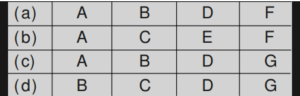
Different arguments are usually put forth in favour of and against power-sharing. Identify those which are in favour of power-sharing and select the answer using the codes given below. Power-sharing:
- reduces conflict among different communities
- decreases the possibility of arbitrariness
- delays the decision-making process
- accommodates diversities
- increases instability and divisiveness
- promotes people’s participation in government
- undermines the unity of a country
Answer:
Correct answer:
(a) A, B, D, F
(Explanation logic: These statements show benefits like reducing conflict, preventing arbitrariness, accommodating diversity and promoting participation.)
Question 7
Consider the following statements about power-sharing arrangements in Belgium and Sri Lanka.
- In Belgium, the Dutch-speaking majority people tried to impose their domination on the minority French-speaking community.
- In Sri Lanka, the policies of the government sought to ensure the dominance of the Sinhala-speaking majority.
- The Tamils in Sri Lanka demanded a federal arrangement of power-sharing to protect their culture, language and equality of opportunity in education and jobs.
- The transformation of Belgium from a unitary government to a federal one prevented a possible division of the country on linguistic lines.
Which of the statements given above is correct?

Answer:
Correct answer:
(d) B, C and D
Reasoning:
- B is correct → Sri Lanka followed majoritarian policies.
- C is correct → Tamils demanded federal power sharing.
- D is correct → Belgium became federal to avoid division.
- A is incorrect → Belgium followed accommodation, not domination.
Question 8
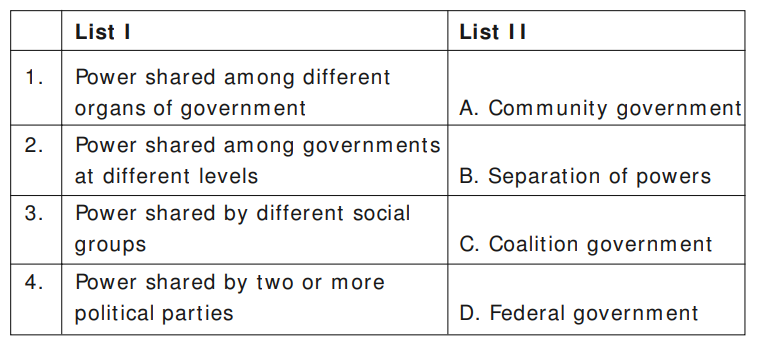
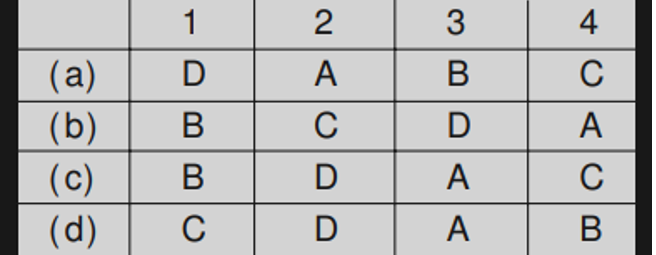
Match List I (forms of power-sharing) with List II (forms of government) and select the correct answer using the codes given below in the lists.
Answer:
Correct matching:
1 → B (Separation of powers)
2 → D (Federal government)
3 → A (Community government)
4 → C (Coalition government)
Correct option: (c) B D A C
Question 9
Consider the following two statements on power sharing.
- Power sharing is good for democracy.
B. It helps to reduce the possibility of conflict between social groups.
Which of these statements are true and false?

Answer:
Both statements are correct because:
- Power sharing strengthens democracy.
- It reduces conflict by giving representation to different groups.
Correct option: (b) Both A and B are true